Wildcats in Action: Community Curriculum Day Bridges Divides
Every four years, timed to the presidential election, Winsor’s on-campus community shifts from our regularly scheduled activities to come together for Community Curriculum Day.
The entire Winsor community including parents and alumnae were invited to help kick off the event on Monday, October 28 with a virtual panel discussion—Bridging Divides: Fearless Conversations with Mónica Guzmán, the author of I Never Thought of It That Way: How to Have Fearlessly Curious Conversations in Dangerously Divided Times. The event was a collaboration between the Engagement Office and the Office of Community and Inclusion. Over 100 families participated in the virtual panel, which was moderated by Julian Braxton, Winsor’s director of community and inclusion and holder of the Bezan Chair for Community and Inclusion. Panel participants included Winsor alum and parent Fatima Aziz ’06, P’32, Winsor student Bibi Noury-Ello ’25, and Winsor alum and Science Faculty Eve Elizondo ’17. The panel’s themes of fostering understanding across differences offered an opportunity to explore how open, fearless conversations can bridge divides in our increasingly polarized world. The event challenged perspectives and encouraged us all to engage with curiosity and empathy—themes that were echoed in the school program the next day.
On Tuesday, October 29, as part of a school-wide conversation on the 2024 election, students and faculty spent a full day in civic discourse. The program was dubbed “Winsor Wildcats in Action: Civic Engagement and Bridging Divides” and featured a multitude of student-led workshops, guest speakers, and political leaders who engaged with students, faculty, and staff throughout the day. Additionally, Winsor students voted on division-specific ballot initiatives during a school election.
To start the morning, Winsor’s Upper School met in the Brock-Wilson Gymnasium to hear arguments for and against the proposed ballot initiative: Should we have a monthly no-cell phone day? While 41% of the Upper School student body wanted to forgo cell phones once a month, ultimately 59% of students who cast votes wanted to keep their phone access and the initiative did not pass.
The whole school gathered in the David E. and Stacey L. Goel Theater for the opening assembly “America in One Room” with Alice Siu, associate director of the Deliberative Democracy Lab at Stanford’s Center on Democracy, Development and the Rule of Law. Ms. Siu explained that the widespread and booming use of streaming platforms and social media has created a society without a collective understanding or common experience. Where you once could assume people watched the nightly news, now the sheer volume of content choices means that everyone is watching something different. Fed by an algorithm that continues to present users with content they will like, we are less often presented with diversities of opinion, especially the opposite opinion.
Both issue polarization—how we feel about certain issues, and affective polarization—whether we like each other or not, are on the rise. “The American electorate have come to like politicians in opposite parties less and less, leading to a more polarized society where one half of the population dislikes the other, and vice versa, simply because they are ‘on the other side,’” explained Ms. Siu. Thinking that deliberation is the antidote to polarization, Ms. Siu and the Deliberative Democracy Lab have set up several social experiments.
One such experiment, “America in One Room,” challenges these notions by placing voters across the political spectrum in the same room to deliberate on a variety of complex issues. Winsor students have experienced a version of this in Mr. Braxton’s Politics of Identity course. Throughout the semester, Winsor students have been meeting on Zoom with a high school in Sidney, Montana to discuss political issues.
“Part of what’s also been illuminating for me is that political views that contradict mine have gone from abstract to concrete,” explains Mina Feldman ’25, a student in Mr. Braxton’s course. “These ideas don’t just exist in the news or on social media. They’re attached to kids my age who like the same bands and video games and movies as I do. We still disagree on a ton, but I think in a lot of ways, we’ve become more human to each other.”
The Community Curriculum Day was based on this idea of deliberation and humanizing the people behind the “other” viewpoint. Students attended their choice of workshops run by peers and visiting guest speakers.
Several alumnae returned to campus to run Upper School workshops, including Sage Stossel ’89 (“Political Cartooning”), Marisa Greenwald Keeney ’02 (“Health Care in America”), and Hailey Fuchs ’16 (“Covering Presidential Elections”). Winsor parent Jeannie Suk Gersen ‘P25 participated too (“The Supreme Court and the 2024 Election”). Additionally, Upper School students planned and conducted over a dozen workshops based on their own interests and of their own design, looking at topics such as “The Role of Social Media in the Election,” “Endorsed Politics: Celebrities and Campaigns,” “I Approve This Message: Exploring Presidential Ad Campaigns,” and “SOMOS Jeopardy: Exploring Voto Latino,” among others.
During advisory period, based on President Franklin D. Roosevelt’s “Four Freedoms” speech, Lower School students made their own political yard signs, which dotted the Winsor courtyard. They, too, could choose from over a dozen workshops to attend, which were mostly developed by Lower School faculty. “Can you pass the U.S. Citizenship Test? Defining Citizenship and Who is an American” billed one workshop, while another was hosted by World Languages Faculty and Milton School Committee Member Baoying Qiu, “How Did a Girl from Rural China Become an Elected Town Official in the USA?”
Lower School students had their own ballot initiative: Should the Lower School Have a Monthly Mix It Up Lunch Day? The proposed initiative would authorize the Lower School Council to plan monthly lunches where students would be placed in mixed-grade level groups to engage in planned activities. While the initiative did not pass, students still enjoyed exercising their right to vote.
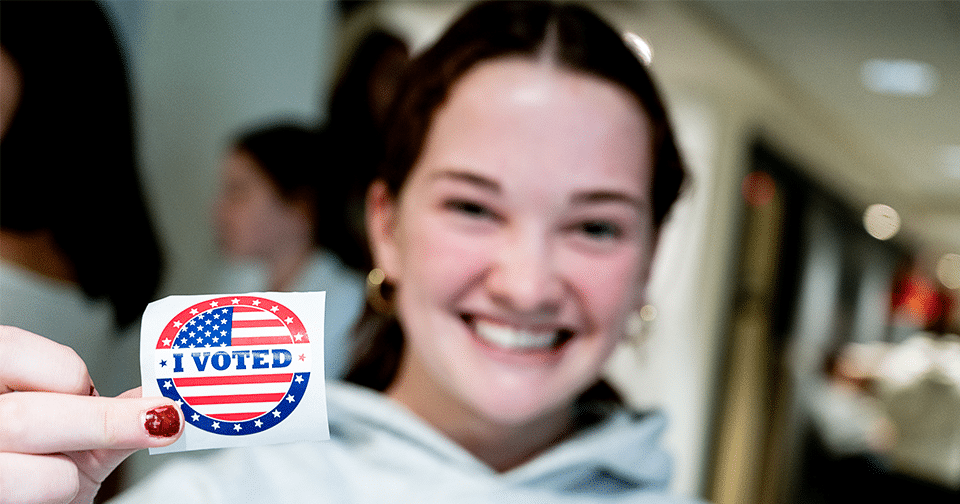
With many sporting “I voted” stickers after a trip to the voting booth during lunch, the Winsor community gathered once more in the David E. and Stacey L. Goel Theater for a closing assembly: “All Politics Is Local.” Moderated by Winsor alumnae Anshi Moreno Jimenez ’15 who works in policy and strategic planning in Boston Mayor Michelle Wu’s office, the panel featured Massachusetts State Representative Chynah Tyler and Director of Communications and Community Outreach Hodan Hashi, who works in the Office of City Council President Ruthzee Louijeune. The rousing discussion covered a variety of topics from imposter syndrome to the low participation and voter turnout in Boston elections. Students asked thoughtful questions about where new legislature comes from, the purpose of events held by elected officials, navigating government for the first time, and how to get involved.
Community Curriculum Day resulted in meaningful conversations across campus and reflects Winsor’s commitment to building a more inclusive, connected community. While students practiced the skills of deliberation and listening, the experience ultimately served to highlight our shared experience, not our differences. Organized by the Office of Community and Inclusion, three people in particular were instrumental in the development of the school-wide program. Thank you to Mr. Braxton and the Lower School and Upper School Community and Inclusion Coordinators, Lisa Stringfellow and Jessica Wang respectively.
For further reading:
A First Look Into Winsor’s Political Climate Winsor Online Banner by Anya Weerapana, October 21, 2024 – The Winsor Online Banner
Our Students in Boston and Montana Speak to One Another and Learn How to Disagree by Julian K. Braxton and Brad Faulhaber, October 24, 2023 – The Boston Globe