





Continuum Fall ’25
Continuum
A Modern Look at the Auction World
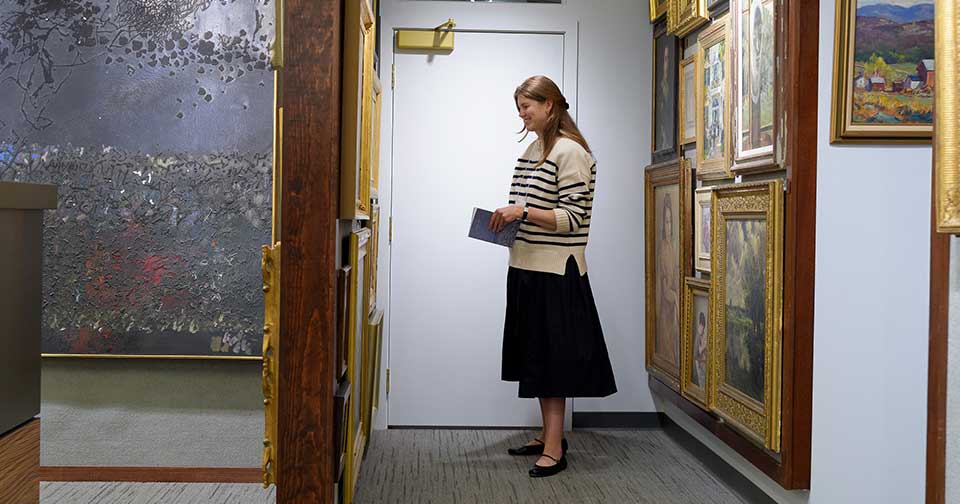
While Winsor hosts alumnae events coast to coast, some are close to home. A demure green awning and golden plaque point visitors to Grogan & Company’s Beacon Hill gallery space. Tucked into the first block of Charles Street, the fine art and jewelry auction house is just steps from the Boston Public Garden and the Boston Common.
Georgina Winthrop ’09, owner and president of Grogan & Company, has been at the firm since 2014. Today, she is the company’s principal auctioneer, oversees company operations, and manages the appraisal, research, and cataloguing of both fine art and fine jewelry for auction. On a quiet evening in April, more than 30 Winsor alumnae and their guests came to meet Georgina and her extraordinary all-female team for an inside look at the auction world and for a chance to have their own items appraised.
There are four reasons someone might sell at auction, Georgina told attendees during a brief presentation, “In the industry, we are taught about the four Ds: death, debt, divorce, and downsizing.” She’s witnessed all sorts of scenarios in her career—a painting can’t be divided among four children, moving from 10,000 square feet to a studio apartment—where clients need liquidity.
But why buy at auction? “It’s an open marketplace,” explains Georgina. “If you go into a jewelry store or a gallery, there’s an asking price that you have to pay. Whereas at auction, the bidding starts at a certain very low amount and proceeds upwards until there is only one person left who wants to pay that price. It’s what’s called ‘the fair market value’ of an item.”
And since it’s not a museum, part of the fun of an auction is also being able to touch the paintings and try on the jewelry—something Winsor alumnae and guests were able to experience ahead of the auction for “A Celebration of Color: The Saundra B. Lane Jewelry Collection.” The collection was sold to benefit the Museum of Fine Arts, Boston. The proceeds, which buyers from across the globe ultimately drove to a total of $3 million, will establish the Saundra B. Lane Fund for Jewelry and shape the museum’s jewelry collection for generations to come. “We’re very proud of the fact that the MFA picked us to sell the collection,” said Georgina, who is also vice chair of the Steering Committee for the Museum Council at MFA. All 97 lots in the auction found buyers, with more than half the lots selling above their pre-sale estimates.
There’s been a tangible shift in the auction market, and also in Grogan & Company’s business model, since the auction house opened in 1987. It used to be typical for a regional auction house to sell the whole house top to bottom—rugs, silver, clocks, furniture, tables and chairs, all antiques. With the advent of the internet in the 2000s, people realized their possessions were not rare. As baby boomers inherited the table and 12 chairs that belonged to grandma, for example, they experienced low demand. Simply put, buyers today do not want, nor do they have need for, traditional items like a large dining set, because they are living in smaller spaces, not settling down or moving every few years.
“The market was flooded in the early 2000s with these traditional collecting categories,” explains Georgina. As a result, prices plummeted. “We look at appraisals that we did in the ’90s and we literally have to move the decimal point. These items are worth 10% of what they used to be.” While that can be a challenging reality for people to face, especially with cherished items on the line, “there are other ways to think about value,” says Georgina, “sentimental value, family value…these things are still special and old and handmade.”
With auction values changing, as a business, Grogan & Company had to adapt, too. The auction house moved their headquarters from Dedham to their current location on Beacon Hill. Out went the grandfather clocks and sideboards, things that were a little hard to fit in a 2,500-square-foot gallery. “We made the decision to really specialize when we moved to this smaller location in 2014,” says Georgina, “We decided to focus specifically on estate jewelry, American paintings, and Oriental rugs.”
Not only did their inventory change, the way they conducted auctions did, too. Instead of 75 people jockeying in a room, “on sale day, we are seeing maybe 15 bidders in person, and the rest is just our auctioneers, a webcam, and the world watching,” explains Georgina. Auctions at Grogan & Company are livestreamed by thousands of people watching from the comfort of their homes or from the sidelines of their kids’ soccer games. “Livestreaming is a phenomenon that really revolutionized our industry at the beginning of the pandemic,” she says. “The businesses that were set up to have this technology were able to jump ahead in reaching thousands more people than we used to be able to.”
It’s also leveled the playing field for buyers. “I think previously someone in California or in England would feel like, ‘What am I not getting? Or what do I not know because I’m not there in person to look at the item or to talk to the specialist or bid in the room and make eye contact with the auctioneer?’” Now Georgina and her staff are FaceTiming buyers ahead of sales, sending photos and videos, and answering questions.
Indeed, buyers have more ways than ever to gather information and make a bid. Yes, they can bid in person, but also over the phone and online. If the sale is happening at an inconvenient time or if the buyer is afraid they’ll get carried away, an absentee bid allows a buyer to advance a maximum bid that keeps them in the running up until that threshold.
Georgina cautions buyers to remember that their invoice will include more than their bid amount. Auction houses make money by charging a buyer’s premium, which is industry standard. A practice that Christie’s and Sotheby’s started in the late ’70s and early ’80s, the buyer’s premium is an additional 25% on top of the hammer price. “And if you live in Massachusetts,” quips Georgina, “you’ve got to pay sales tax, too.”
Throughout the industry, there can be other fees, as well. Some auction houses charge to bid online, notes Georgina. “They’re passing on those expenses of having that functionality on their website.” Shipping is another fee that buyers sometimes neglect, and Georgina herself is not immune. She once bought a mirror for the mantelpiece of her apartment from an auction house in New Jersey. “I felt like I got this great deal. And then the shipping cost more than what the item cost,” she recalls. “So pay attention to where the item is coming from, also how much it weighs. We’ve had instances where someone buys a bronze, but then no one has the special equipment to get it out of here.”
Georgina also has advice for what buyers should consider in advance of bidding on an item. Aside from the facts and figures—for paintings: artist, size, medium; for jewelry: carat weight, known maker, diameter of the bracelet, etc.—she encourages people to go deeper and think critically, and really do their homework. Making sure the painting is authentic, for example, can be a time-intensive process. “Often for significant artists, there’s an individual or a committee who has to give their blessing to a painting before it can be sold,” explains Georgina. In some cases, authentication by committee is only offered once a year. “There’s more lead time than you might think from taking something out of a home to getting it ready for prime-time to be seen by the world,” she says. It’s important that all parties—auction house, seller, and buyer—are aware of what needs to happen for a specific piece and ensure that it has happened prior to it being sold.
Aside from authenticity, condition and quality are important factors too. “These paintings are, in some cases, 200 years old, so you expect them to have some condition issues, but you want to ask, has there been restoration, is there damage, what does the condition report disclose?” reminds Georgina. With paintings, quality is both about good, better, best—and also understanding where this painting falls in the artist’s body of work. “Is it a still life and the artist really is better known for landscapes? Maybe that means you don’t want to spend as much,” says Georgina, who credits a Winsor education with developing her skills to succeed in this role.
“It’s research skills,” says Georgina of her work in the art world. “It’s part knowing where to look and whom to contact.” While she has a Rolodex of experts, she also credits the advent of technology with “flattening of the art world,” saying, “I can email a person in Germany who is the person for this German artist and, while I’ve never talked to her before, we can have a very productive correspondence about a painting,” she explains.
For jewelry, the focus is more on certification. The quality of gemstones comes from a third-party scientific opinion, quite different from the research component for paintings. Long before they’re assigned a lot number in an auction, colored stones (sapphires, rubies, emeralds, etc.) are sent to a gem lab in New York called the American Gemological Laboratory, the AGL. Following a chemical analysis that identifies where in the world the stone was mined, the AGL provides a certificate of origin and information about whether the stone has been heat treated to enhance the beauty or the richness of the color. For diamonds, buyers should be expecting to see a certificate from the Gemological Institute of America detailing cut, color, clarity, and carat weight.
Georgina encourages buyers to ask themselves, am I going to find something just like this a week from now, a year from now? Or is this my only chance to have this thing? These sorts of questions that can only be answered if a buyer has done their homework. And while buyers can consider the tangible, it’s perhaps the intangibles that make auctions exciting. “If it reminds you of your childhood home, or this necklace is just like one that your grandmother wore every day, there are a thousand different emotional reasons why something is worth more to one person than to the next,” says Georgina. She notes, “That’s where the fun of an auction really begins, when there are two people who have done all their homework, they know what an item is worth, and they’re just going to keep bidding.”
Alumnae were invited to bring their own small items to the event and have them appraised through an expert’s eye. Using loupes and handling people’s treasures with care, Georgina, who has completed coursework at the GIA and is USPAP (Uniform Standards of Professional Appraisal Practice) compliant through 2027, as well as Gallery Director and Senior Specialist Claudia Deeley, who holds a degree from the GIA in jewelry, diamonds, and colored stones and is USPAP compliant through 2026, examined everything from coins to cameos. “What collectors look for in coins is irregularity, a mistake at the foundry,” Claudia told Lindsey Miller Santiago ’03, before promising to share a coin expert’s contact information for further exploration. Cameos are “hard to sell in today’s market,” she told another alumna, “but keep it for sentimental reasons.”
The appraisals yielded a few unexpected boons—a peridot and diamond brooch that belonged to an alumna’s aunt was appraised at $3,000–$5,000. A bombé-style cocktail ring Jane Hoffman ’80’s father commissioned for her mother features an old European cut single diamond surrounded by an outer rim of baguette diamonds. While examining the ring from every angle, Claudia casually shared style history including the fact that the dome and spray form was originally popular in the 1890–1930s but had a resurgence in the 1970–1980s when Jane’s father had the ring made. Claudia appraised the piece at $2,000–$3,000 at auction.
“This was really fun,” Jane said, laughing.


Always Learning, Always Growing
“Winsor graduates do love their opportunities to be in a learning environment, and to talk about literature,” notes Jennie Skeele ’71, P’98, ’02, retired English faculty. As part of her work with the Winsor Alumnae Board’s Education Committee, Jennie tapped two fellow former faculty, Judy Robbins and Tyler Knowles, to lead a virtual discussion about a series of selected poems. The event, which took place on Zoom in February, drew more than 60 alums from around the world who were eager to listen, ask questions, and offer their own reflections on poetry and its impact on their lives.
“I run into a lot of alumnae at Winsor events, and they’re always asking for more events that focus on learning,” noted Jennie, who led a popular virtual discussion of Jane Austen’s Pride and Prejudice last year. “We have this stable of extraordinary teachers at Winsor, both current and retired, and I knew Tyler and Judy would be a perfect fit. They are a dynamic pair—they both read and think magnificently, but they don’t always agree. I knew it would be wonderful if we could tap into that dynamic.”
Because of the high level of interest for the discussion, Jennie says, the format shifted from a roundtable conversation with participants to more of a fireside chat between Judy and Tyler, with participants offering comments and feedback via the Zoom chat. “People were just delighted,” Jennie says. “They were so excited to listen to these two wonderful teachers—and readers—talk about wonderful poetry together.”
Jennie herself recalls being a student at Winsor under Judy, who “inspired me to love literature and be just like her when I grew up.” She notes that her experience is common: “Many alumnae truly value the discussions we had about literature at Winsor, because of our wonderful teachers, our roundtable style of teaching, and the environment where everyone’s ideas are welcome. Some alumnae have said that even their college classes couldn’t measure up! It was wonderful to offer a bit of this experience again to alumnae.”
Through her leadership on the Winsor Alumnae Board, Jennie and the board’s education committee have plans to expand the virtual education series, tapping faculty members in other departments at Winsor to offer future sessions focused on science, history, or other disciplines. She’s also collaborating with an alumna on a Charles Dickens reading project, and is excited to see what other doors may open.
“It says so much about the alumnae population from Winsor,” Jennie says of the enthusiasm for these online discussions. “They are hungry to continue learning and make time for it, even when they have their own incredibly busy lives.”
Hundreds of Alumnæ Join Virtual Art Tours
As an historian, educator, and longtime museum docent, Julie Roy Jeffrey ’58 sometimes thinks she knows a painting or sculpture quite well. But since developing and sharing themed tours of the Walters Art Museum, first in person and then over Zoom during the COVID-19 pandemic, she has found herself engaging with familiar pieces in new ways.
Julie began offering these virtual tours to her Winsor classmates during lockdown, and this year, she partnered with the school to offer them to the entire alumnae community. The response has been enthusiastic—especially among alumnae who remember the art history sequence that provided an interdisciplinary perspective during their time at Winsor. But alumnae from various eras, Julie says, have been intrigued and delighted by the tours.
“It gives people a chance to do something they can’t always do, whether in the Boston area or elsewhere,” Julie says of the tours’ appeal. “The Walters is a more important museum than many people realize, and it’s located in Baltimore, which is not part of everyone’s travel plans. But I think having someone develop a meaningful way to look at the art from any museum is very attractive.”
Julie’s series of three Zoom lectures, each with a different focus, examines a handful of pieces and “touches on both educational and artistic themes that Winsor grads enjoy,” she says. “Placing a painting in its cultural and artistic context is very stimulating. It offers an opportunity for me to dig deeply, and I enjoy that research as I’m developing a tour. And for attendees, a coherent, or perhaps unexpected, way of thinking about the art is very interesting.”
Julie is working on her next series, one she says may include highlights from the Walters’ jewelry collection, which dates back to ancient Mesopotamia. She’s also considering a lecture on images of beauty, and how artistic standards of beauty have both influenced and been influenced by female viewers of artistic works.
Now a docent at the Smithsonian American Art Museum, Julie is also enjoying the chance to explore a different museum’s collection. “The policy of giving docents the freedom to develop their own tours has been very important to me,” she says. “Both the Walters and the Smithsonian have broadened the way I think about art.” Through her virtual tours, Julie is doing the same for the Winsor community.