



Chris Player Awarded Inaugural Bondoc Family Fellowship
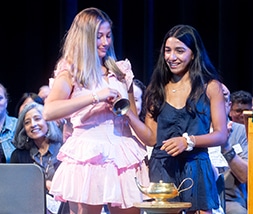
At an all-school assembly on January 30, Science Faculty, STEM Coordinator, and Innovation Lab Coordinator Chris Player was awarded the newly established Bondoc Family Fellowship in Science, Technology, Engineering, and Mathematics. The three-year fellowship, established by alumnae Victoria Bondoc ’77 and Josefina Bondoc DeBaere ’75, was created to recognize and support the compensation for a Winsor faculty member who has served the school for between 5 and 20 years. The recipient, as Head of School Meredith Legg P’32 said at the assembly, is “a faculty member who embodies what it means to be a Winsor teacher: someone who leads with integrity, inspires students to see possibility in themselves and the world, and sparks excitement for learning, especially in STEM.” To Mr. Player’s colleagues and the administrators on the selection committee, he represented “the ideal inaugural recipient” of the fellowship.
A stalwart of Winsor’s science faculty since 2012, Mr. Player has played a crucial role in shaping the school’s STEM initiatives, “collaborating with faculty across disciplines to infuse innovation throughout the curriculum,” said Ms. Legg. “His leadership and vision have helped define what STEM education at Winsor can be, and his work continues to inspire generations of young women to see themselves as capable, curious thinkers.”
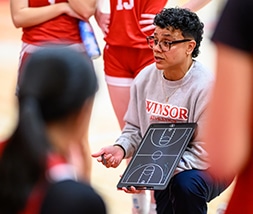
Head of Upper School Kimberly Ramos describes Mr. Player as “someone who is a tinkerer, who probes, who asks questions, who’s constantly recreating curriculum, redesigning projects, working with students and trying to make sure that he’s speaking to their interests—someone who wants students to have a purpose for their work.”
This sense of purpose infuses Mr. Player’s approach to teaching subjects such as engineering and design. “Some people love science gadgets just because they love science gadgets,” explains Ms. Ramos, “and he does, but he really loves science gadgets that improve lives.” She described a year in Mr. Player’s Engineering class during which the class worked primarily on adaptive technologies, and on helping people using technology. With Mr. Player’s STEM education mindset, she says, “It’s not just, ‘Can I make this thing happen?’ It’s, ‘How can I improve the world with this thing?’”
Denise Labieniec, one of Mr. Player’s colleagues on Winsor’s science faculty, describes being constantly impressed by his ability to create “exploratory, open-ended learning” experiences for his students, while imparting valuable ways of thinking along the way. “For Chris, it’s his principle of operation in the classroom,” she says. “It’s really amazing, the freedom that kids have in his classrooms to learn through exploration” while still guiding the experience towards “work the kids are proud of at the end,” Ms. Labieniec says. “I think [that environment] is built into the STEM program overall.”
Ms. Labieniec describes Mr. Player’s classroom ethos as both richly abstract and interdisciplinary—a key asset for a faculty member tasked with helping to infuse STEM concepts throughout the Winsor curriculum. In teaching design, Mr. Player’s approach is to ask, “How do we take principles of design, physical conceptualizations of form, need, empathy, ethics, and creativity, and address a problem that’s by its very definition multidisciplinary?” she says. “When he teaches chemistry, it’s the same thing: How do we talk about quantum physics in a way that captures the mechanisms of thinking and the social zeitgeist and everything that was going on at that time?”
“He brings this incredible abstraction” that draws students in and invites them to ask their own questions about the subject.
Both Ms. Ramos and Ms. Labieniec underscore Mr. Player’s transformational role in guiding Winsor’s STEM curriculum. “It’s a signature program now because of his innovative thinking and his concept,” says Ms. Labieniec. Underpinning that curriculum, says Ms. Ramos, is the goal of developing “habits of thinking.” She explains, “An enduring pattern in all of his teaching is that it’s all about helping students to be empowered, and to have the tools to really reason and think through the process.” It’s a concept that Mr. Player has worked to infuse throughout Winsor’s STEM offerings.
She points to an early change Mr. Player made to an engineering class he was slated to teach—even before the STEM curriculum was designed—as an example of this mindset: “He immediately changed the course title to Engineering Design,” Ms. Ramos says. Mr. Player wasn’t primarily invested in developing engineers, she explained. However, he felt that “everyone should be able to understand the design process and how to think like an engineer,” she says. “He wants people to pursue the world with that type of thinking.”
Mr. Player, who is also a musician, has spoken publicly about the connections between jazz improvisation and his own habits of thinking. In a TEDx Talk titled “Free Jazz, Disability, and Wires,” he tells the story of sneaking into a jazz club when he was young and being told by an older musician to always carry his saxophone with him—to always be ready to step on stage and improvise. Ms. Labieniec extends the metaphor: “I think he gives all the kids horns, teaches them how to play them, and expects them to always have them with them, no matter what they’re doing.”
“Let’s step forward with disregard for what happens, because the risk is worth it,” Mr. Player says to the audience in his talk, “because it’s an adventure, because something special might come about.”
Congratulations to Mr. Player on receiving the inaugural Bondoc Family Fellowship in recognition of the many special things that have emerged from his endless innovations, his improvisational spirit, and his deep dedication to Winsor’s students.