




The Big Story Fall ’26
In This Issue
140 Years and Counting
The Winsor School has been devoted to excellent education for girls in Boston since its founding in 1886. Throughout these past 140 years, Winsor has prepared girls to speak powerfully, rewrite the rules, and guide decision-making to make the world better.
While the professional opportunities available to women have multiplied exponentially since our founding, our faculty have long prepared students to thrive in careers—including those that were once reserved for men. As society has changed, we have evolved to ensure we remain on the leading edge. While new science wings and refreshed athletic spaces are equally important to our evolution, Winsor traditions form the backbone of every student experience—traditions that make Winsor, Winsor.
In celebration of 140 years, we reflect on some of the enduring events, competitions, publications, and iconic objects that have helped shape this inimitable school.
116
Years
Miss Winsor's Bell
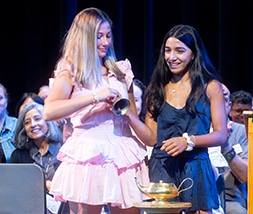
The gentle chime of Miss Winsor’s Bell has opened and closed each school year since 1910. Made of brass with a leather strap, the bell is displayed (along with the lamp) in the head of school’s office year-round. The honor of ringing the bell was first given to the Class IV Lower School Council heads in 2005.
At the Lower School Closing Ceremony, a pair of newly elected rising Class IV students take the stage in the David E. and Stacey L. Goel Theater. One of their first tasks in office is to ring Miss Winsor’s bell, signaling the end of the school year, the conclusion of the Lower School Closing Ceremony, and the beginning of summer. The following fall, on the first day of school, the same Lower School Council heads ring the bell on stage again, this time officially kicking off the year as students transition from Convocation back to academic classes.

A gift from the Class of 1910—the last class to graduate from Miss Winsor’s on Beacon Street—the lamp is a cherished and handmade Winsor artifact. At the 1910 dedication of the new schoolhouse on Pilgrim Road, the lamp rested on a pedestal, as it still does at Convocation each fall and at Commencement each spring. At the initial dedication, Susan Hallowell Brooks, Class of 1901, referred to it as “the Lamp of Learning whose product is the Light of Truth.”
In the fall, the senior class president carries the lamp and leads the procession of students into the David E. and Stacey L. Goel Theater for Convocation. Again in the spring, they lead the procession of students and faculty into the Commencement tent. At Commencement, during the singing of “The Lamp of Learning” by Gretchen Howes Waldo, Class of 1902, care of the lamp is transferred from the current senior class president to their recently elected successor.
Lamp iconography is a symbol of Winsor and is featured on the Winsor class ring, the official Winsor seal, and also in the newly redesigned Winsor logo.
116
Years
The Lamp

115
Years
Head of School Portraits
Only nine women have led the school during its 140-year history, a sign and source of Winsor’s leadership stability. As each leader closes her time at Winsor, her tenure is marked with a portrait. The portraits hang on the third floor of the Virginia Wing Library.


Established by an original corporator, Harriett Hemenway, the Hemenway Prize for Speaking Competition traces its roots to 1913. The competition challenges seniors to develop and deliver a speech of substance, and reflects Winsor’s long-held belief in the importance of public speaking skills and the ability to speak one’s mind. A strong, outspoken woman and animal rights activist, Miss Hemenway founded the Mass Audubon Society in the late 1800s.
Each March, the entire senior class comes together in the David E. and Stacey L. Goel Theater and listens intently as members of the class deliver their own thoughtfully crafted, five-minute speeches. More than just a platform for soon-to-be graduates to showcase writing and presentation skills, the competition is a unique and powerful bonding experience for the seniors. The head of school, head of Upper School, and senior class dean attend the special day while advisors drop in to hear speeches from their student advisees throughout the day.
Through their speeches, the seniors are challenged to share something that they have learned, something that matters to them, or something they want others to understand from their perspective. Ranging from heartfelt to lighthearted, students share stories that bring listeners to tears and to their feet.
After hearing speeches from the entire class of over 60 students, five finalists are selected by a panel of judges along with input from every member of Class VIII. During an all-school assembly, finalists present their speeches again, this time to the entire school. It is truly the speech of a lifetime. Indeed, crowd support is often deafening in volume.
The judges are typically two faculty members and one alumna (often a former Hemenway Prize winner). The speeches are judged based on substance, organization, style, presentation, and clarity. The winner of the Hemenway Prize for Speaking Competition is announced at the Awards Celebration each June.
113
Years
Hemenway Prize for Speaking Competition
111
Years
The Lamp
The Lamp dropped its first issue in December 1915. Described as a magazine to be “issued quarterly by the girls of the Winsor School, Longwood, Mass.” and “run” by them, a year’s subscription was $1. Early editions included stories and poetry alongside editorials, essays, school news, and alumnae class notes, which later migrated to the Bulletin magazine.
Today, the Student Association of Fine Arts (SAFA) publishes a yearly issue of Lamp, which has evolved into an arts and writing magazine. As an Upper School club, SAFA is dedicated to fostering artistic engagement at Winsor by creating a community to share and create art. During club meetings, students explore different types of art and discuss art history and current events.
Each spring, SAFA opens up submissions. “If you draw, write, paint, sculpt, take photographs, or create any kind of visual art, we encourage you to submit to Lamp!” read last year’s call for submissions, which was shared with the student body via email. In recent years, Lamp submissions have included drawings, paintings, photography, short stories, poems, and pictures of sculptures and ceramic pieces.


As bright and eager Class I students begin their Winsor careers in fifth grade, programs such as the Class I play are intentionally designed to develop student bonds, forge friendships, and bring the class together. As far back as 1920 and annually since 1939, Class I students have spent a good portion of the year working together on a full-blown production as actors, singers, and dancers, with sets, props, costumes, and lighting, which is later performed for the whole school.
Longtime Choral/Music Director and former Eleanor T. Nelson Chair in Fine Arts Lisa Taillacq, who taught at Winsor from 1978 to 2020, recalls the Class I play was often a selection from the Gilbert and Sullivan opera repertoire of the Victorian-era theatrical duo dramatist W. S. Gilbert and composer Arthur Sullivan. The Class I play “became a bonding experience for the newest students entering the school,” said Ms. Taillacq. “It showcased the talents of Class I students and introduced them to our Winsor family in a very special way, making it a very beloved tradition.”
Today, the Class I play is a Winsor world premiere. Inspired by global folk tales and stories, Theater Director Jeremy Johnson writes an original play, while Choral Director Andrew Marshall composes original songs. Costume Designer Jessica Pribble makes the vision come to life, Dance Faculty Anne-Marie Caraldi creates choreography, and Technical Director Andrés Puigbó, along with the stagecraft crew, works behind the scenes. The never-before-seen performance debuts at an all-school assembly with an encore performance for families.

106
Years
Class 1 Play
104
Years
Alumnae Weekend
As many as 250 alumnae return for Alumane Weekend each May. The tradition of the weekend and class reunions traces its beginnings to the early 1920s. As early as 1907, a desire for connection to each other and the school spurred passionate alumnae to establish the Graduate Club of Miss Winsor’s School, now the Alumnae Association. The year of Miss Winsor’s retirement in 1922 marked the first of what became annual luncheons for alumnae. The events have grown in scope through the years—and shifted to the evening in 1987.
Today, there are reunion dinners on Friday night and programming on Saturday for alums to take classes with Winsor faculty, peek into the archives, hear from students, and take tours of the school. From noon to nine, campus comes alive with opportunities to celebrate alumnae accomplishments through the Alumnae Service Award, Young Alumnae Award, and Julia Lyman Simonds Distinguished Alumnae Award. Alums share reflections on the past and hopes for the future through our 25th and 50th reunion speeches, and enjoy the laughter, stories, and timeless bonds that make Winsor feel like home.


Each fall, juniors have the opportunity to purchase a Winsor School signet ring engraved with the enduring symbol of the lamp of learning.
According to a February 1926 issue of The Lamp, Winsor rings were discussed in heated homeroom debates. The Lamp editorialized: “Doesn’t it seem a trifle lacking in that elusive quality defined as ‘school spirit’ not to want a school ring, as an eternal, lasting bond between ourselves and all other classes of Winsor, those that have gone before and those that will come after?” By the end of that academic year, a committee selected a plain gold ring with a W in the center. “The school is to discuss the ring and vote as to whether we are to keep it,” read an entry in the 1926 graduation issue. The discussion must have led to the design we know today. Winsor rings continue to be a memento that links generations of Winsor students.
In recent years, “Ring Day” has become an exciting spring event on campus where seniors present juniors with their class rings. While the special day is supposed to be a surprise, juniors always seem to find out when it’s happening. In practice, a senior is matched with a junior and prepares a colorful poster or stages a proposal. While the seniors line up in the courtyard, the juniors rush outside to find their match and receive their ring. The scene is joyful (and boisterous) and has become a favorite Winsor tradition marking junior spring.
100
Years
Winsor Rings
95
Years
Class IV Shakespeare Play
A longheld tradition dating back to 1931, Class IV students have the incredible opportunity to study the Bard of Avon together. “Shakespeare is a major capstone event for the entire class,” explains Theater Director Jeremy Johnson. “It allows them to work with each other on a common goal.” Twelfth Night (the first play produced), The Tempest, and A Midsummer Night’s Dream hold a three-way tie for the most productions at 14 each. Since a different play is selected each year, alumnae across generations often compare the tragedies, comedies, and histories they participated in, forging instant connections with classmates decades apart.
The theater program at Winsor has grown a great deal since the Lubin-O’Donnell Center opened in 2015. Historically, there was just one version of a play, with some students on stage and many others behind the scenes. With the exception of a single filmed production during the pandemic, since 2017 and under the guidance of Mr. Johnson, there is now a dual play format. For example, during the 2025–26 school year, Class IV performed two separate productions of Romeo and Juliet—one set in Renaissance Verona, Italy, in keeping with the original script, and one set a bit further afield, in the Wild West of the mid-1800s.
The dual-play format is a clever and practical solution to ensure all Class IV students are equally involved in the production of a play with a limited cast. “Each student acts in one play and then serves on a committee supporting the other play,” explains Head of Performing Arts Felicia Brady-Lopez. Committees include those responsible for the set, costumes, and music. “The sets are painted, the music is played, and all backstage work is completely done by the Class IV students,” says Mr. Johnson—with preparatory teaching and guidance from Technical Director Andrés Puigbó, Costume Designer Jessica Pribble, and Music Director Andrew Marshall.