



Continuum Spring ’26
Continuum
Alumnae Return with Wisdom from the Journey
The Winsor community regularly invites our alumnae back to campus, and last semester saw the return of familiar faces now making names for themselves in the arts, sciences, and business. Whether speaking to a club over lunch or presenting to the whole school during assembly, these alumnae exuded confidence, competence, and clarity of purpose in their chosen fields, and they were happy to offer advice and stories of life after Winsor. Here are some snapshots from recent visits.
Seeing Creativity Everywhere
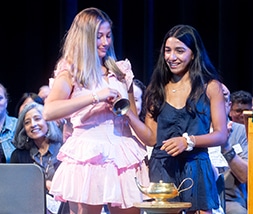
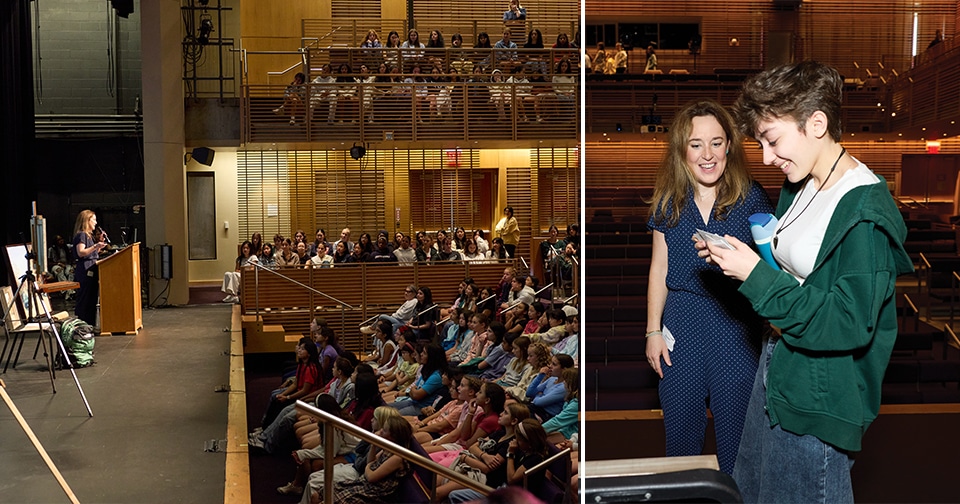
SAFA, Winsor’s fine arts club, hosted painter Meghan weeks ’04 at all-school assembly. She returned as a working artist, eager to share the journey that carried her beyond Winsor’s art studios to a plein air easel in Boston’s South End and far beyond.
At Winsor, Meg arrived in Class III and committed to taking advantage of every possible opportunity. She found a home in the art studios under the mentorship of faculty like Visual Arts Department Head Sara Macaulay.
After Winsor, Meg studied architecture, then earned a graduate degree in curation. She built a career in curatorial and outreach roles at the National Galleries of Scotland, the Isabella Stewart Gardner Museum, and the Boston Public Library. Then, in 2022, she took the leap to become a full-time professional artist.
Today, Meg—in addition to her role as president of Winsor’s Alumnae Board—is a plein-air painter, working outside, on site, in every kind of weather. Her paintings have been exhibited widely, and she has earned juried membership in a number of regional artists’ societies.
Meg encouraged students to see creativity everywhere. “The world needs more creatives,” she told students. “Whatever you do, go out there and be a creative.”

Building Humanity’s Future
Emerging-technologies designer Sana Sharma ’10 returned to Winsor to share her work at the intersection of science, art, engineering, and design. Today Sana is cofounder and advisor at Aurelia Institute, a nonprofit dedicated to building humanity’s future in space for the benefit of Earth.
She also leads research at the MIT Media Lab for the Astronaut Ethnography Project, which uses interviews and other qualitative methods to learn more about life in space beyond the mission or the science. “We’re really curious about everyday life and what that feels like in zero-G,” explained Sana.
Sana also spoke about an Aurelia Institute project exploring space architecture that helps answer the question, “How are we going to make space enjoyable?” She described leading the development of the TESSERAE Space Pavillion—a modular, self-assembling space architecture made up of magnetic tiles that stack flat in the payload fairing of a rocket. In zero-G, the seven-foot-wide tiles self- assemble into a structure resembling the geometry of a soccer ball. “The hope is that we can attach more and more of these soccer balls to…organically grow a space habitat,” she said.
“I am so excited to see what future you all build,” she told the students, “as well as how you might invite your communities to join in in that building.”

Staying Curious
Running a Nigerian tomato-paste company was never part of the plan for Mira Mehta ’02. But when you “stay curious,” as she encouraged students in Winsor’s Venture Capital and Entrepreneurship Club, life takes some fascinating turns.
After years of rowing for Winsor and then Brown University, Mira set aside her early ambition to become an Olympic athlete and found herself pivoting to a career in public health. Working on HIV programs in Nigeria, Mira witnessed the stigma and economic hardship the virus caused. “It felt like what people really needed is money,” she said. “So that got me interested in the idea of being a business owner.”
During her travels through Nigeria, Mira noticed vast fields of cut tomatoes drying in the open air. But when she bought ingredients for jollof rice and other West African dishes, the tomato paste always came from China. “Why are we not processing [the tomatoes] locally?” she wondered. So at Harvard Business School, she developed a business plan and launched her social enterprise, Tomato Jos, which today employs 100 workers and supports about a thousand farmers.
“You have to have that stubbornness in you,” she told the students about the risks of running a business. “It is a dream, and I’m trying to make a dream become reality.”