



Annual MLK Social Justice Assembly Brings History to Life
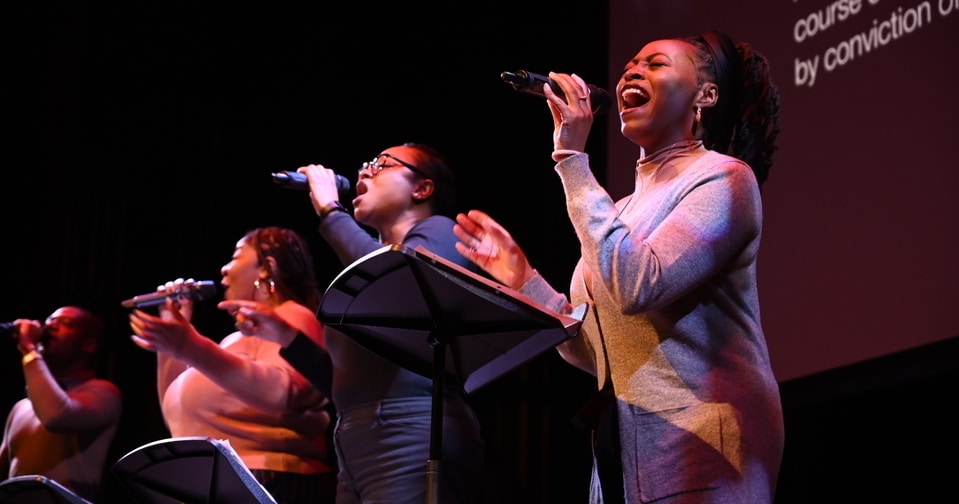
Winsor’s annual celebration of Dr. Martin Luther King, Jr.’s life and legacy took place during a special all-school assembly. Following the federal holiday, Winsor gathered students, faculty, and staff in the David. E. and Stacey L. Goel Theater to present “At the Table with Dr. King.” A multimedia performance, the program highlighted key events of the American Civil Rights Movement and inspired participants to make valuable connections between the past and present, learning lessons of equality and respect through music, spoken-word poetry, historical video footage, and Dr. King’s own words.
With multiple musicians across guitar, keyboard, and saxophone, as well as four dedicated vocalists, the team behind “At the Table with Dr. King” took the Winsor audience on Dr. King’s journey from doubt to civil rights leader.
Accompanied by musicians, the assembly began with a recorded sermon of Dr. King recounting a particularly frightening midnight call on January 27, 1956 (“Knock at Midnight”). This defining moment at his kitchen table took place when Dr. King was just 27 years old. With a wife and young infant at home, Dr. King considered taking a step back from the Civil Rights Movement to protect his family. At the time, as a second-year pastor of Dexter Avenue Baptist Church in Montgomery, Alabama, he was helping lead the city bus boycott, which brought an ongoing barrage of death threats to his doorstep. Some days, there were as many as 30 to 40 phone calls.
But on that day in January, seated at his kitchen table, Dr. King recalls a voice telling him to “stand up for righteousness, stand up for justice, stand up for truth.” Using that moment in time as a springboard, “At the Table with Dr. King” immersed the Winsor audience in the sights and sounds of the Civil Rights Movement. The audience journeyed through history alongside Dr. King, making stops along the way that brought the Civil Rights Movement to life and highlighted important moments in history.
For example, using photographs and video footage, a stop in Birmingham, Alabama—where in August 1963 Dr. King and countless other adults and children were imprisoned for participating in nonviolent demonstrations against segregation—helped frame the “Letter from Birmingham Jail.” Penned in longhand by Dr. King as a response to a public statement of concern and caution issued by eight white religious leaders of the South, his call to action—“let us not seek to satisfy our thirst for freedom by drinking from the cup of bitterness and hatred”—made all the more sense after seeing the situation from his perspective behind bars.
The program brought the audience to the “March on Washington for Jobs and Freedom” on August 28, 1963—where Dr. King made his famous “I Have a Dream” speech—and the Memphis, Tennessee sanitary worker’s strike in March 1968, where Dr. King received a restraining order.
“His friends didn’t abandon him,” explained assembly leaders. “They were willing to face the chaos with him.” They added, “When you’re trying to do the right thing in the right way, in the middle of so much wrong, you will need your friends, and your friends will need you.” With performances like “Precious Lord, Take My Hand” and “This Little Light of Mine” the assembly was deeply inspiring.
The last stop in history was April 4, 1968 with Dr. King’s heartbreaking asasanation and a look at vivid photographs of the funeral days later, but the message of hope endured. Looking to the future, students, faculty, and staff were challenged to engage in creative acts of service in their communities. “Turn to someone next to you and say, ‘I’ll take you there,’” encouraged the assembly leaders.
To end the program, the entire Winsor community joined in singing “I’ll Take You There” by The Staple Singers and left the theater inspired to make their world a better place.
“At the Table with Dr. King” is co-production the Mizel Museum in Denver, Colorado and More Than Music. The Mizel Museum is dedicated to fostering cross-cultural understanding, combating racism, and promoting social justice through educational programming, events, and exhibits.