
Curriculum Guide
Performing and Visual Arts
Class I
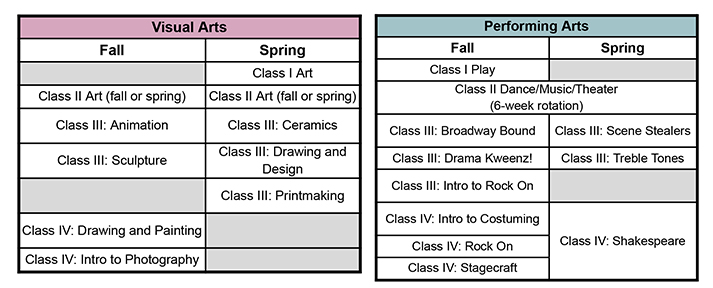
Class I students will spend their first semester being part of an original theater production taught by our theater, choral, and dance faculty. The students will sing, dance, and act in the production, which will culminate in two January performances, one for the school community and one for Class I parents. During the second semester, Class I students will study visual arts where the emphasis is on developing imagination and a creative disposition. In addition, Class I students will participate in the yearlong Performing Arts Block during the school day on Tuesdays and Thursdays by joining Chorus I/II, Class I Dance, String Ensemble, Wind Ensemble, or Orchestra (by audition).
Class II
Class II students will study a full semester of visual arts and a full semester of performing arts, divided into six weeks each of dance, theater, and music, setting a foundation for more elective choice in Classes III and IV. In addition, Class II students will build a foundation in music and/or dance through required participation in Performing Arts Block during the school day on Tuesdays and Thursdays by joining Chorus I/II, Class II Dance, String Ensemble, Wind Ensemble, or Orchestra (by audition).
Classes III and IV
In Class III and the first semester of Class IV, students will begin an exciting elective program in the arts. Students will choose one arts course each semester from a variety of offerings in visual arts, music, dance, and drama. Second semester, Class IV students will participate in a collaborative drama experience in the form of a Shakespeare play, supplemented by other performing arts opportunities in music, costuming, and technical theater. Students in Class III and IV can continue participating in the Performing Arts Block by joining Class III/IV Dance, Descants, or Orchestra (by audition).
Performing Arts
Class III Courses
Dance
Broadway Bound (Fall)
Students from beginner to advanced dance levels will learn musical theater and contemporary techniques as seen on Broadway and contemporary dance stages. They will also build their strength, flexibility, coordination, and rhythm while dancing as an ensemble. Students will have the opportunity to perform pieces inspired by the works of legendary dancers and choreographers of the past and present in the annual Winter Dance Concert along with the Upper School Winsor Dance Team.
Theater
Acting: Drama Kweenz! (Fall)
Students will be introduced to short form improvisation and learn how to create outrageous characters through fast-paced skits. Students will be introduced to mask work and clowning, exploring physical comedy and slapstick. The semester will finish with an introduction to comic Shakespeare scenes in preparation for the Class IV Shakespeare project. Students may request only one semester of acting.
Acting: Scene Stealers (Spring)
Students will learn audition techniques by studying, rehearsing, and performing a monologue. They will discover how to create vivid and truthful characters using clues from the script, as well as how to increase their confidence onstage. Students will work on contemporary scenes in pairs, focusing on how to approach a scene in an emotionally truthful way. The semester will finish with an introduction to dramatic Shakespeare scenes in preparation for the Class IV Shakespeare project. Students may request only one semester of acting.
Music
Introduction to Rock On (Fall)
In this beginning rock band class, students will explore playing ukulele, acoustic and electric guitar, electric bass, drum kit, digital keyboards, and singing with a microphone. They will read music using treble and bass clef notation, chord charts, and tablature, and they will practice ear-training and harmony singing. Students will also develop their sense of rhythm and collaboration skills while experiencing how much fun it is being in a rock band with their peers. All levels of music experience are welcome.
Treble Tones (Spring)
Treble Tones gives students the opportunity to sing a cappella in a variety of styles, including classical, Disney, and pop music, while building confidence in music reading and harmony singing. Students explore vocal techniques within popular styles and are assigned to one of three vocal sections. Students learn their voice parts and then sing together as a group. Solo and small groups within the larger ensemble may also learn other songs and practice separately. Treble Tones will showcase its work in a low-key performance at the end of the term. All levels of music experience are welcome.
Class IV Courses
Semester 1
Introduction to Costuming (Fall)
Students will be introduced to the myriad of skills necessary to bring together the costume design of a production. The course will introduce concepts in script analysis, rendering, costume design, and technology. As a project-based course, students will work collaboratively to create costume pieces for characters from plays and literature. The course is an opportunity to learn practical sewing techniques, develop creativity, and practice problem solving skills. All levels of sewing and drawing experience are welcome.
Stagecraft (Fall)
Students will be introduced to theater principles through hands-on exploration of lighting, set design, and sound. They will learn to operate the sound board and light board, to use a variety of tools in the scene shop, and to use various scenic painting techniques. The students will be trained within a supportive and safety-conscious environment that introduces them to aspects of professional theater. In addition, students will have ample opportunities to apply their skills in real-world settings by assisting with assemblies and performances.
Rock On: A Survey of American Music (Fall)
Students will explore the history of American popular music as they choose songs to learn from the 1960s to today. They will have the opportunity to play instruments of their choice, including guitar, bass, drum kit, piano, and synthesizer, while incorporating previously acquired musical skills. Additionally, students will practice stylistic singing, develop harmony, refine microphone technique, and enhance their stage presence and personal expression. As the band prepares for their final performance for the school community in January, they will cultivate a strong sense of teamwork and collaboration.
Semester 2
Shakespeare Project (Spring)
All Class IV students participate in the annual Shakespeare Project which involves performing two adaptations of a Shakespeare play that students read in their first semester English class. In addition to acting in one of the shows, students will contribute to the project with their work in costume, music, or set design with the overall goal of exposing students to various aspects of the production process. The project will culminate in performances for Upper and Lower school students in May along with a separate parent performance.
Lower School Performing Arts Block (PAB)
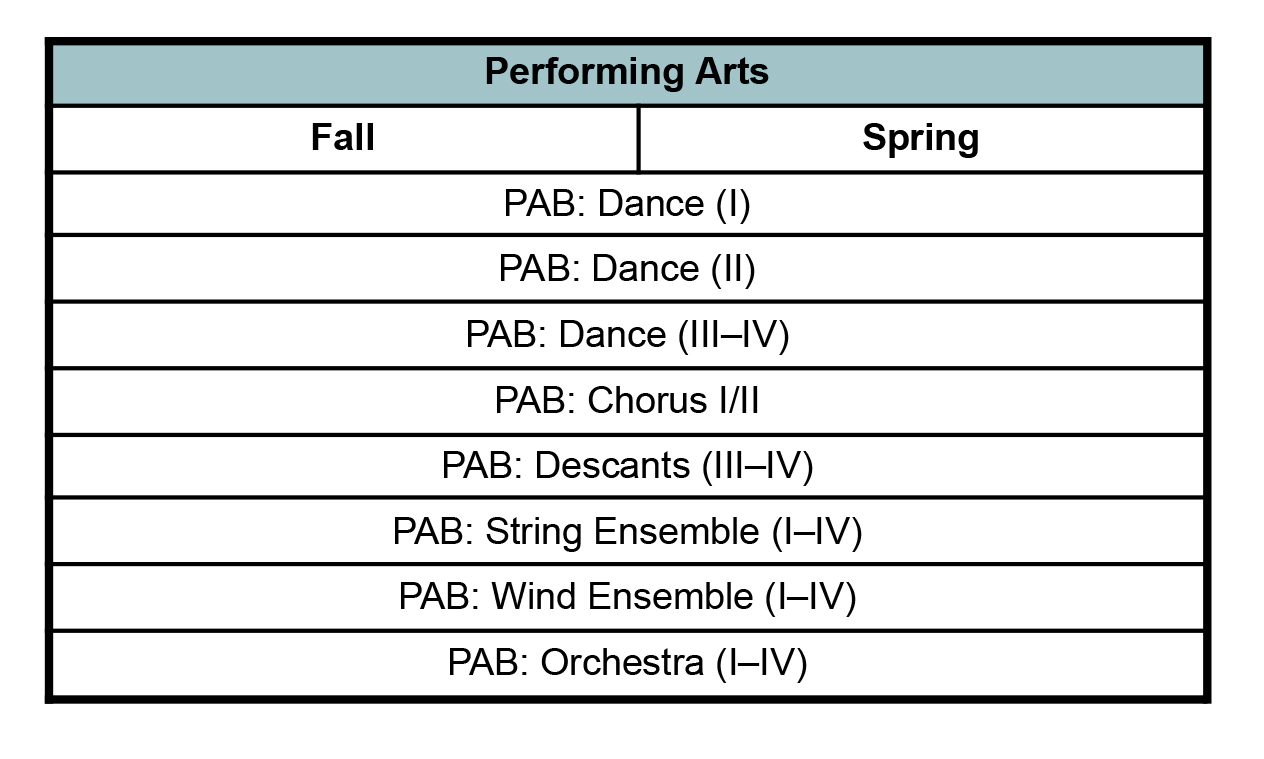
The Lower School Performing Arts Block (PAB) takes place during the school day on Tuesdays and Thursdays, supplementing Performing Arts electives. This yearlong program includes chorus, dance, and instrumental ensembles, taught by Winsor Performing Arts faculty and professional adjunct instructors. Participation in PAB is required for Class I and Class II students, while Class III and Class IV students are strongly encouraged to continue but may choose to attend a study period instead.
PAB Dance Ensembles provide an opportunity for students to dance in an ensemble with their peers in Class I, Class II, or Class III/IV.
- PAB Dance Ensemble (Yearlong)
Each ensemble will participate in a one-semester immersive training in one of the following genres: Afro-Haitian, jazz, modern, or South Asian dance. In the second semester, students will rotate to a different genre. The PAB dance ensembles will perform in the annual winter and spring dance concert assemblies along with the Upper School Winsor Dance Team. No prior experience is necessary.
PAB Instrumental Ensembles offer instrumentalists the chance to perform in an ensemble setting with peers from various grade levels. Students of all abilities are welcome to join one of the following groups: String Ensemble, Wind Ensemble, and Orchestra (by audition). Students will complete a brief audition either in the spring of 2026 or at the start of fall 2026 to ensure placement in the appropriate group. All ensembles will perform throughout the school year. Students are required to provide their own instruments.
- Lower School String Ensemble (Yearlong)
This group is open to violin, viola, cello, and bass students with approximately zero to three years of playing experience. Students will develop fundamental skills, such as tone, intonation, and note reading, while learning to play in a larger ensemble. Students are required to provide their own instrument. It is strongly encouraged that students in this ensemble also sign up for private lessons in our After School Music Program. Open to Classes I–IV. - Lower School Wind Ensemble (Yearlong)
This group is open to woodwind and brass students with approximately zero to three years of playing experience. Students will develop fundamental skills such as tone production, intonation, and note reading, while learning to play in a larger ensemble. It is strongly encouraged that students in this ensemble also sign up for private lessons in our After School Music Program. Open to Classes I–IV. - Lower School Orchestra (Yearlong)
This group is open to intermediate and advanced string (violin, viola, cello, bass, harp), woodwind (flute, oboe, clarinet, bassoon), brass (trumpet, tuba, trombone, french horn), percussion, and piano students with at least three years of playing experience. Students will strengthen their musicianship and ensemble skills while learning a diverse set of repertoire. All students should be comfortable playing in a variety of key signatures with up to four sharps and flats, and string players should be able to shift to different positions. Pianists may be asked to play percussion. All string, woodwind, and brass students are required to provide their own instrument. All students must complete an audition in late spring or early fall 2026. Classes I–IV.
PAB Singing Ensembles provide an opportunity for students to get to know their individual voices while experiencing the joy of singing with peers in other grade levels. Both groups will perform throughout the year.
- Chorus I/II (Yearlong)
Chorus I/II offers students a fun and supportive environment to explore various music styles while discovering the potential of their own voices. Students will sing in unison and up to three parts, developing basic choral skills such as pitch matching, tone production, and breath control. They will also refine their sight-singing abilities and learn how to follow a conductor. Open to Classes I–II. - Descants (Yearlong)
In Descants, singers will further develop their skills while performing in unison, two, and three parts. They will focus on intonation, ensemble balance, dynamics, phrasing, emotional connection with the text, and advanced performance techniques. Open to Classes III–IV.
Visual Arts
Class III Courses
Animation (Fall)
In this class, students will explore several different methods of storytelling through a range of traditional and digital animation techniques from flipbooks and charcoal drawings to Claymation, digital animation and looping animated GIFs; students will learn how to use storyboarding, lighting effects, character design, foley and audio editing, and composition to plan each frame of a story. Students will become familiar with different programs including iStopMotion, iMovie, and Procreate.
Sculpture (Fall)
In this class, students will explore a range of materials such as clay, plaster, wire, papier-mâché, and found objects, as well as a variety of techniques such as building, carving, and modeling. Students will work conceptually, from observation, and with abstraction on projects that range in size from an egg to a life-size form.
Ceramics (Spring)
In this class, students will learn many hand-building techniques, including pinching, coiling, and slab construction. Throughout the semester, students will consider three-dimensional form and surface treatment as they develop craftsmanship and personal expression. Use of various tools and different glazing techniques will be introduced.
Drawing and Design (Spring)
Through assignments that include sculpture, drawing, and painting, students learn to apply the elements of design and the principles of drawing both two- and three-dimensionally. Students will work from their imagination, from observation and from photographs on projects that include paper sculptures, celebrity portraits, tessellating patterns, and an introduction to oil painting.
Printmaking (Spring)
This course will provide students with an introduction to a wide range of traditional and contemporary printmaking techniques including relief, intaglio,monotype, and serigraphy as well as revisit familiar techniques from Class I and Class II, like gelli plate monotypes and linoleum block carving. Students will have an opportunity to print by hand, with tiny etching presses, and with our large studio printing presses. While drawing skills are always helpful, they are not necessary to create amazing prints!
Class IV Courses
Drawing and Painting (Fall)
This course introduces students to a range of approaches for working with paint and other color media, such as pastel and colored pencil, while continuing to reinforce the fundamentals of drawing and design, including composition, line, color, form, and value. Technical approaches range from the traditional style of painting used by the old masters to more experimental mixed media use favored by contemporary artists. While working from both photographs and observation, students will draw from their imagination in an attempt to transform their subject matter in a way that reflects their artistic voice.
Introduction to Photography (Fall)
In this course, students will explore a variety of image-making techniques, learn about the darkroom chemistry and equipment, and apply their understanding of the principles of photography to create compelling compositions. They will learn how to control and manipulate light to create the desired tone, mood, and atmosphere for their images. Starting with sunprints and cyanotypes and progressing to simple camera types including pinholes and 120mm film Holgas, students will complete assignments ranging from still life to portraits and landscapes. They will conclude the semester working with school-issued DSLR cameras and learning the basics of the exposure triangle.