


Paleontology Students Get Hands-On Experience with Deep Time
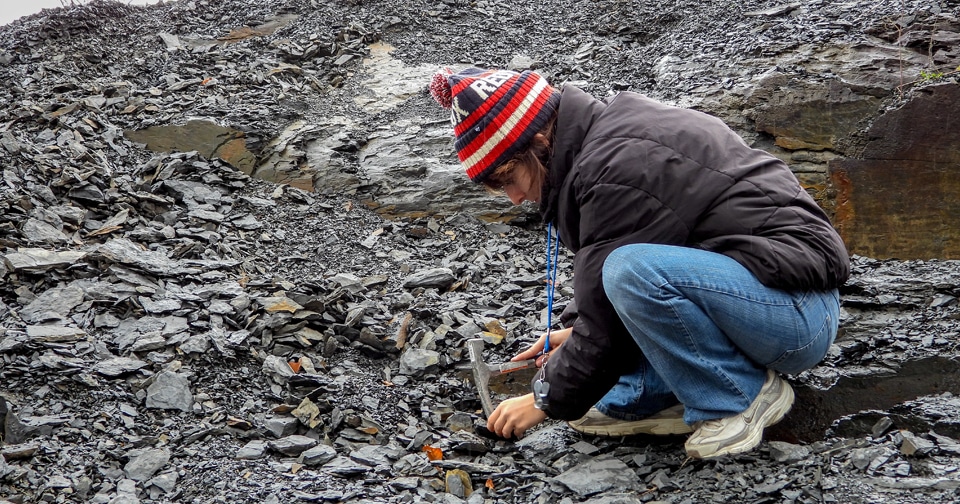
Standing at an outcrop of rock in central New York, Winsor Science Faculty Ken Schopf’s students could see about 380 million years into the past. Part of Mr. Schopf’s Upper School paleontology course, the two-day excursion to this fossil-rich site—and to the Syracuse University laboratory where they would later analyze the samples they gathered—was a chance to touch the actual materials of their collective study: rocks dense with ancient creatures, tools that unlock eons-old data.
It’s a field Mr. Schopf, Winsor’s Essential Chair in Science, knows personally. Coming from, if you can believe it, a family of paleontologists stretching back to his grandfather, he originally studied paleontology in graduate school before transitioning to a career as an educator (though he continues to engage in his former field—just last year he coauthored a paper in the scholarly journal Paleobiology). However, after finding his way to Winsor, he says he’s “still able to use some of those same skills and thinking.”
“For me, it’s been great to be able to bring it to Winsor”—and, then, to bring some of Winsor a few hundred miles inland to pluck fossils from a dried-up sea of Devonian black shale.
But why so far from home? Well, the Commonwealth of Massachusetts has much to recommend it, but it lacks the right sort of geological conditions for a substantial fossil record.
So, departing early on a Saturday morning last semester, the group of students and their chaperones—Science Faculty Mr. Schopf and Ms. Eve Elizondo—traveled to the site outside of Syracuse where they met Syracuse University paleontology professor Dr. Linda Ivany, an old friend of Mr. Schopf’s from his graduate school days. “We collected from the locality for three or four hours. Then we headed back to Syracuse, started the analysis, and continued it the next day,” he says. At Dr. Ivany’s lab in the university’s Department of Earth and Environmental Sciences, students had the opportunity to use a highly sensitive scanning electron microscope, along with a number of other tools.
Mr. Schopf says this was a crash course in the “nuts and bolts” of the science in practice—collecting samples and then attempting to analyze “the paleo environment or the paleo community of organisms that was living there. And by knowing a little bit about the types of fossils that were collected, you can actually say some really interesting things about what the salinity was like, what the oxygen levels were like in the water, how deep it was. You can look at changes in that paleo community through time.”
This concept of tracking changes through swathes of the distant past is central to the course, a half-year science elective for Class VII and VIII called Paleontology: Exploring Data from Deep Time. One of Mr. Schopf’s central ideas is that what we learn about the past through the “historical science” of paleontology can help us understand and make decisions about our future.
“If you’re trying to forecast what our future is going to look like, you can look at things on a human time scale, but we’re usually trying to forecast beyond that,” he says. “Things like computer models and intuitions get wonky. But we actually have data from times in the Earth’s past when carbon dioxide was at much higher levels than today. We have data with varying sea level changes. We have data with less and fewer ice caps than we have today in glacial ice…It’s a really rich source of potential data for modern decisions.”
This trip, then, is about seeing how those big concepts get worked out in the field. Without that hands-on component, “it’s like learning about apple trees, but never actually seeing one.”