


Wellness Project Assembly Offers Tools for Finding Inner Peace on Life’s Journey
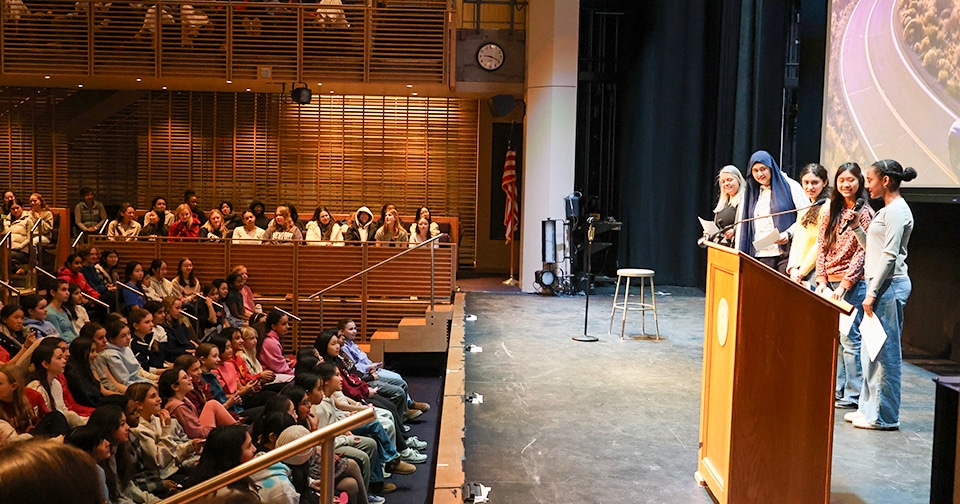
Students, faculty, and staff each showed up to last week’s assembly in the midst of their own journeys. Some were stressed about a deadline, others were anxious about an interpersonal conflict or troubled by something happening in the world outside of Winsor. But on that Friday, February 13, the Wellness Project student leaders—Chloe Lien ’29, Helina Adugna ’29, Sisi Ansari ’28, and Hamna Chowdhry ’26—and their advisor, Wellness Department Head Sabrina Weissbach, stepped onstage to guide the community through a different journey.
This journey was a “road trip” of sorts, said Hamna, focused on “finding your peace” even when life’s conditions get bumpy. Along the way, they were also aided by illustrative reflections from science faculty members Denise Labieniec and Chris Player. The skills and perspectives they offered on how to identify, cultivate, and protect inner peace served as a crucial pit stop for everyone in attendance, who could return to their life’s journeys refreshed and refueled for the road ahead.
On the road to inner peace, “it is important to distinguish what finding inner peace is not,” said Chloe. “Peace is not perfection…We are surrounded by unrealistic, edited, and polished models of lifestyle and habits considered to be ‘healthy’ through social media.” She stressed that inner peace is not conferred by proving ourselves worthy in the eyes of others, “but rather depends on your opinion about yourself.” Further, inner peace coexists with life’s challenges; it’s “not about suppressing any negative emotions,” she said, “but rather finding healthy ways to express those emotions…Peace does not come from avoiding all problems, and it’s not about having no work, homework, or stress in your life.” Accepting that the road gets rough sometimes, and that “we ourselves are not perfect,” is a crucial first step to a deeper experience of peace.
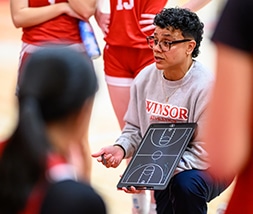
Sometimes, we also need to pause long enough to take stock and rest. “Time management techniques affirm that we need breaks and can’t work efficiently for extended periods of time,” said Sisi. “Like on a road trip, we can’t last the whole trip if we don’t take breaks to refuel. Especially in the midst of schoolwork and activities, we must remember that we need time to recharge and slow down so we don’t get burnt out.”
Sisi also focused on the role that those we care about—and who care about us—can play in the journey toward inner peace. “Reaching out for support and externalizing your emotions is a courageous act of self-care,” she said, adding that it “fosters emotional healing.” She then reflected on her own experience of peace and support within a family routine of sharing daily “check-ins” during which each member shares “three wins from our day, two things we’re grateful for, and one funny thing.” Though she was skeptical of the ritual at the start, “after doing six months of these check-ins almost every night, I can confidently say that I am at peace when I do [them]. Even for just those ten minutes every night, I am with the people I love most, and I can reflect on what made my day great and what truly matters to me, rather than negative aspects that bring my mood down.”
Helina also highlighted “the importance of building community,” saying, “Talking to a person or group of people about your stress helps you because you’re able to have someone that knows what you’re dealing with instead of dealing with it by yourself, which is usually much harder. It’s also helpful for the people that you’re sharing with because it might show them that there’s someone else dealing with stress.”
And while the role of community in cultivating inner peace is important, Hamna reminded those in attendance that self-love and self-awareness are central to that work. She encouraged practices such as journaling, mindfulness, or sharing thoughts with a peer who can listen dispassionately. “By spending some time with your own thoughts, it allows you to become an observer of what’s going on in your mind rather than an active participant,” she said. “Having self-awareness also allows for emotional healing, as it helps you process negative emotions and the triggers or patterns that cause them.”
Journaling, in fact, was raised in several contexts. Chloe discussed keeping a gratitude journal—“every day I take less than one minute to write and think about three things I am grateful for”—and Helina said it was her “personal favorite way of releasing all of my thoughts and feelings at the end of the day.”
But what about all of those things going on outside of us—those conditions in the world that we can’t control? Ms. Weissbach laid out the dilemma succinctly: “In an unpeaceful world, it can be hard to find our peace,” she said. “On your road trip, there might also be potholes, weather, or traffic that will slow you down or make your journey a little more difficult.” Against external headwinds, the best strategy isn’t to deny reality. “Finding your inner peace doesn’t mean ignoring what’s wrong; it means choosing how to respond to it,” she said. “It means learning how to pause, breathe, and ground yourself even when things feel overwhelming. It means being kind when it’s easier to be harsh, standing up for others, and taking care of your own mental and emotional health.”
Ultimately, working to find peace amid the conflict and stress that surrounds us on life’s journey can be a vital, even countercultural act. “In a chaotic world, inner peace becomes an act of strength,” Ms. Weissbach said. “And when each of us works to build that peace inside ourselves, we quietly help make the world around us a little more peaceful too.”