
Now What? Panelists Reflect on the Midterm Election
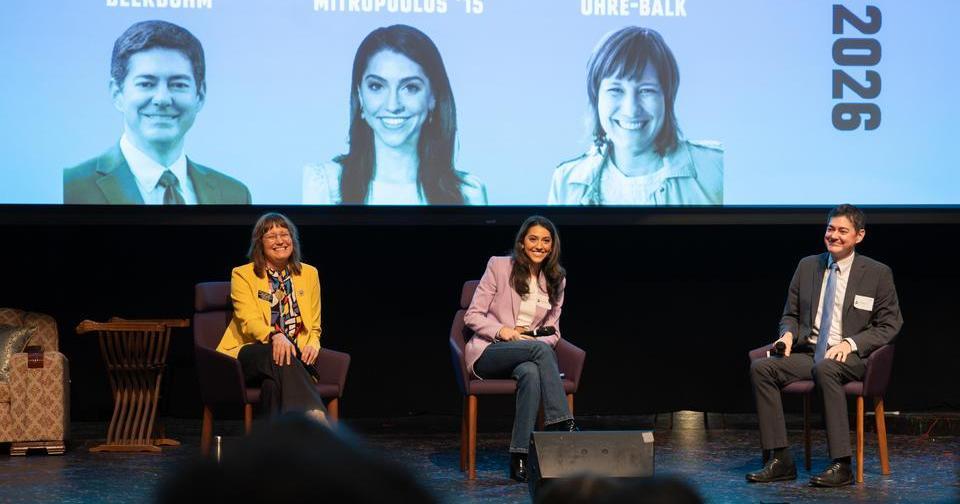
On Friday, November 6, just days after the 2026 midterm elections, Winsor hosted a special panel in the David E. and Stacey L. Goel Theater during assembly for students from Class III through Class VIII. Titled “Midterm Elections Are Over: Now What?,” the conversation asked what the results tell us about the country and what comes next, bringing together three distinct perspectives: a political scientist, a political reporter, and a politician.
The panel featured Eric Beerbohm, Alfred and Rebecca Lin Professor of Government at Harvard University and faculty director of the Edmond and Lily Safra Center for Ethics; Arielle Mitropoulos ’15, a two-time national Emmy Award–winning journalist and reporter for WCVB NewsCenter 5; and Nicole Uhre-Balk, a former member of Winsor’s science faculty and a member of the South Dakota House of Representatives representing Rapid City, who had been reelected just days earlier.
Professor Beerbohm considered what democratic participation asks of citizens beyond casting a ballot, including a willingness to compromise on policies that contain elements with which they disagree. Recalling the 1972 bumper stickers that read “Don’t blame me, I didn’t vote for Nixon” in Massachusetts—the only state Nixon did not carry that year—he asked whether voting means keeping one’s hands clean or being willing to engage in “some kind of hand dirtying.” He also pointed to corruption as “the sleeper issue of this election,” noting that some polls ranked it alongside inflation and the economy among voters’ top concerns.
Ms. Mitropoulos, who spent election night reporting from New Hampshire, framed her remarks around former Speaker of the House Tip O’Neill’s famous phrase, “all politics is local.” “What people really care about is what’s happening in their backyards,” she explained. Drawing on her daily conversations with voters, she said the cost of gas and groceries currently weighs most heavily on people’s minds. “The number one thing that I hear from voters is they just want to be able to afford life,” she shared.
As an elected official, Representative Uhre-Balk offered a different perspective. “Just 72 hours ago, I didn’t know how I was going to be responding to this question because I didn’t know if I would be elected,” she acknowledged. Having first run in 2024 under the slogan “From the Classroom to the Capitol,” she described policymaking as “one big giant group project,” before asking students to rate participation in group projects on a scale of zero to five (opinions were mixed). As a member of a small minority party in her state legislature—in fact, when initially elected, she was the first Democrat to represent her district in 18 years—she explained that progress depends on finding common ground. She shared that she had already reached out to a newly elected colleague with very different views to propose working together, explaining that holding different political views doesn’t mean they face different problems. Thanking former colleagues, she credited Winsor with much of her professional development and with teaching her how to “call people into the conversation while also calling people out and continuing to build relationships.”
During the Q&A portion of the assembly, students from both the Lower and Upper Schools asked about legislative priorities, political polarization, and the panelists’ career paths. Asked how teaching shaped her work as a legislator, Representative Uhre-Balk pointed to her science classroom: “Trying to use facts, evidence, all those kinds of things that are important in science definitely helped me in my political career.”
Asked whether the election marked a step toward depolarization, Professor Beerbohm said it was too early to know and cautioned against what he called “political procrastination” in Congress. “If you’re always looking at the next election, you’re always risk-averse about losing it. You’ll never actually accomplish anything legislative,” he said.
When a Lower School student asked what drew her to journalism, Ms. Mitropoulos described her lifelong curiosity about current events, recalled her nerves during her first live shot, and credited WCVB anchor Maria Stephanos for pushing her in front of the camera. She acknowledged the privilege of both “holding the power accountable” and giving “a voice to the voiceless, the people whose stories are not being told.” She also reflected on her time as a Winsor student, telling the audience that Winsor helped her find her voice and that an A+ is not everything. “There are so many things that will catapult you forward after this institution,” she said.
Though the three panelists approached the election from different vantage points, from the lecture hall and the newsroom to the statehouse, their reflections returned to a shared idea: the work of democracy does not end when the votes are counted. Whether by holding leaders to their promises, seeking common ground across the aisle, or simply staying curious and informed, each speaker offered students a glimpse of what civic life looks like after Election Day.