



Stephen Murdock Celebrates 20 Years at Winsor
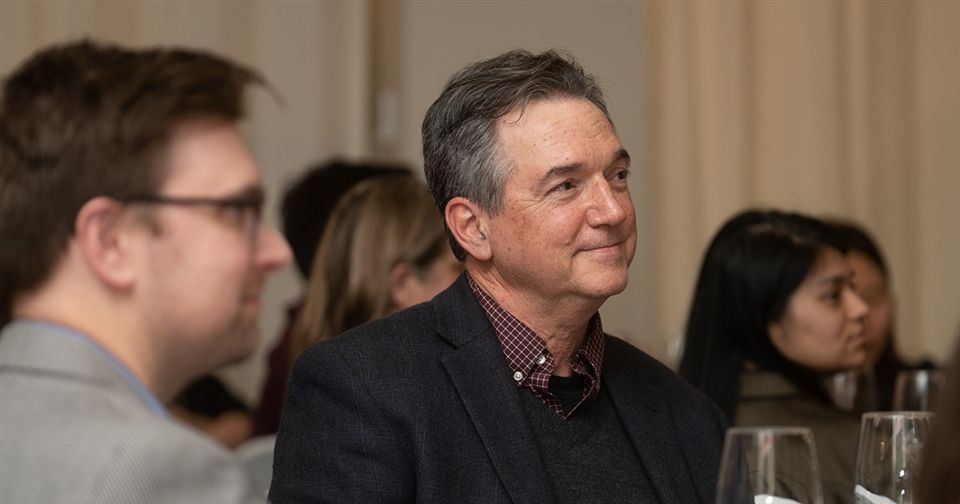
Each winter, the Winsor Board of Trustees hosts a seated dinner for the faculty and staff to celebrate major milestones and to honor their Winsor tenure. At the annual Faculty, Staff, and Trustee Dinner on Tuesday, December 5, 2023, English Faculty Stephen Murdock celebrated 20 years of service to the school.
Ms. Pelmas’s remarks are excerpted below:
When I first arrived at Winsor, I heard stories about the mysterious, philosophical, talented Stephen Murdock, but where was he? Well, it turns out he was on sabbatical that fall, but most everyone here knows that he is not always easily found in the conventional spaces like, say, the English Department office. In fact, he does much of his best work in hallways! Ask almost anyone, and you will hear about the rich conversations that started with him in the hallway on the way to the dining room or as he is headed to his informal “office” in the LOC, or in transit before or after school. And these conversations certainly aren’t limited to his classes or to his beloved Irish literature. First of all, there is his daughter Genevieve, his son-in-law Matt, and his grandchildren, Graham and Oliver. I’m confident that if you ask him, he’ll happily share some photos—and likely a story or two—about these most important people in his life. There’s also woodworking, fly fishing, sailing, monsters, existentialism, the nature of authenticity, religion, racism, colonialism, problematic authors, and who knows what else. This is quite a list—I think we’d all do well to find ourselves more frequently in the hallway with Stephen.
And of course, these rich discussions happen inside the classroom, as well. According to English Department Head Courtney Jackson, “Students praise the sometimes meandering, but always fascinating, nature of Stephen’s class discussions. They’ll start with a moment in text and find themselves covering a huge range of topics by the end of the period! Sometimes these topics include fly fishing and adorable grandchildren, but more often they are deep and complex explorations of literary, historical, and philosophical concepts—from transcendentalism to deconstruction theory to the Irish literary renaissance. Anyone who has had a conversation with Stephen knows he can talk! And you always come away from those conversations a little wiser—and frankly a little happier—because Stephen is just so excited about ideas (and grandchildren!).”
Stephen has been at Winsor now for 20 years. Former colleague Jennie Skeele ’71 P’98, ’02 recalls how marvelous Stephen was from the moment he applied for the position. “Through the years,” she writes, “Stephen proved a constant resource of knowledge and interest, both in the areas he knew so well and had studied on his own and in the new literature we were exploring to enrich our curriculum. As we developed the Indigenous Peoples unit for U.S. Literature, we knew that Stephen’s own far-back Native ancestry helped fuel his commitment to what we were doing. When, each spring, we talked over the various possible selections for a required summer reading book for the Class VIs, Stephen’s opinion always helped inform our wisest choice. He is an astute reader himself and has an intuitive sense of what will grab tenth grade readers. … [and of course] To understand the metaphors in Frederick Douglass’s “The Meaning of the Fourth of July to the American Negro,” one really does need a working knowledge of a sail boat.”
During the past two decades, Stephen has taught a number of courses, including American Literature, Irish Literature, and Monstrosity and Society. And, according to Denise Labieniec, we may have missed out on a few classes he should have been teaching. She wrote, “My most favorite conversations with Stephen over the years fall somewhere in the categories of ‘contraptions I made to move really heavy things’ and ‘things students should be taught but aren’t.’ One day several years ago, when discussing the latter during a slightly-longer-than-it-should-have-been lunch the week before December break, we joked about the ideal course called ‘how to survive a zombie apocalypse’ which we would co-teach. [Is it weird that these days surviving a Zombie apocalypse seems more of an essential life skill than it ever has?]. We would teach things like how to tie a knot and, yes, how to move heavy things because, we believed, being able to do these things is empowering.”
Beyond teaching his regular courses and planning for the zombie apocalypse, Stephen was a sensitive and supportive dean for many years, a Panel/Banner advisor, a faculty advisor for both the Philosophy Club and Mt. Pleasant Community Service, and joined Jennie Skeele ’71 P’98, ’02 as a chaperone for a literary trip to England in 2012—though, I’m told, he lobbied hard and repeatedly for a detour to Ireland. Of Irish descent himself, Stephen is perhaps most passionate about teaching Irish literature and history. Even students who aren’t sure they will be interested in Irish literature or who find Joyce and Yeats daunting at first end up loving his senior elective.
Class VII’s Bibi Noury-Ello ’25 gives us a window into perhaps the more impish side of Stephen’s students, when she tells a story of trying to see how long the class could get Stephen to talk about fly fishing. (I understand that it was 25 minutes?) The true point of her comment is that Stephen makes everything relevant to everything else, and fly fishing is no exception!
At an event in New York for Winsor alums last month, I had a long talk with Becca (Willard) Sherman ’09, who told me that she and classmate Caty Rea ’09 “were so inspired by [Stephen’s] Irish Literature class junior year, that during our gap year before college, we spent the year in Dublin where we studied WB Yeats, Roddy Doyle, Oscar Wilde, and Samuel Beckett.” Addressing Stephen in a note, they said, “Remember when you had us dissect Portrait of the Artist as a Young Man? Turns out those skills came in crucial in trying to understand Irish pub banter—a handy life skill, we assure you! Thank you for your dedication to helping us become better writers, the thoughtful discussions on Irish history, and the inspiration to explore the land of unpredictable weather, beautiful literature, and endless green hills.”
Interestingly, several of the students who enthusiastically responded to our request for stories about Stephen were from the Class of 2020. Despite the challenges of teaching remotely to seniors who would have much preferred to be on campus, Stephen created what one student described as a “rich, immersive environment” that kept the students engaged, learning, and perhaps most importantly, experiencing a palpable sense of joy during his remote classes. Elizabeth Martin ’20 organized a video tribute with her classmates, which Stephen will get later, in which they talked about his skill in keeping them connected and supported through that very challenging spring—with several gimmicks, including dressing as a knight—with a helmet that appears to have been fashioned from aluminum foil.
Elizabeth describes Stephen’s approach to the classroom, saying, “Mr. Murdock encouraged us to push the limits of arguments and analysis, saying ‘let’s take it too far, let’s stretch this idea,’ a mental exercise that became an effective strategy to foster analytical thinking and cultivate a class environment where brainstorming and free thinking were valued over rigid answers. As a student, I didn’t fear being right or wrong, all of us embraced this playful intellectual curiosity.”
And of course, members of the class of 2020 are not alone in their affection for Stephen. As class dean for the Class of 2015, Stephen is also well loved by that cohort. Arielle Mitropoulos ’15 enthusiastically describe Mr. Murdock as steadfast and solid, noting that “To say Mr. Murdock had his hands full with our class would be an incredible understatement. From the very first day that he began overseeing us, my class never failed to make his life… well, to put it nicely, much, much, much more difficult! There was not a week that would go by without my class being reprimanded for some blunder or transgression….eating in the homeroom, talking during assembly, having our phones out, walking out of a pep rally when our class lost…and breaking countless other rules. However, Mr. Murdock truly had the patience of a saint….He guided us through tragedies and difficulties like the Boston Marathon bombing, the loss of the incredible Mimi Minkoff, or when one my classmates lost both of her parents…[and he was there] as well as through successes—when we were accepted to colleges, won athletic awards, or simply did well on a paper or test. Through it all, Mr. Murdock was always there.”
It’s impossible to overstate just how valuable that sense of safety—and feeling seen—can be for our students. Alum Katie Borkov ’15 comments that, “As a teenage girl, there was no shortage of forces which encouraged me to doubt the worth of my interests and abilities. But in Stephen’s classroom my contributions were valued; I was empowered to be an unabashed individual. Since graduating, college professors and workplace supervisors alike have lauded my ability to write with emotion and precision, which I owe to the incredible English department at Winsor as a whole, but particularly to Stephen, who convinced me of the value in my voice, and helped me see what I could offer myself and the world through language.”
But of course, language can be used in many ways! Colleague Andrea Chase shares this story: “My first year, I was the youngest member of the department. One day I was sitting in the department office with Jennie Skeele ’71 P’98, ’02. I needed to write a recommendation for a student, so I asked Jennie how she typically writes recommendations. Jennie, of course, had many incredible examples to show me. I noticed that, at the end of all of them, she had added “Carolyn McClintock Peter Chair in English.” I said wistfully, ‘I wish I had the name of a chair to put at the end of my recommendation.’ At this moment, Stephen walked into the room and, without missing a beat, said ‘You can have the department highchair.’” Podmate Laura Krier notes, “I relish our chats, whether we are catching up about our families, thinking through how to best navigate DEIB practices in our classrooms, or stringing together as many puns as possible in a pod meeting (often nautical, of course). I’ve come to appreciate that Stephen is invariably even-keeled, charting a curricular course that fosters an atmosphere of exploration and thoughtful discovery.” David Griffin adds, “If you want a decent metaphor, ask Stephen. Or a pun. And definitely a boat or a cabinet built of reclaimed wood from a shipwreck or…well, now I’m feeling inadequate, and I blame Stephen.” And Ned Henningsen chimes in, “Stephen will probably hate to hear this—sorry, Stephen—but he is a font of wisdom both about teaching and about life. Along with pranking his desk in the department office, should he ever return to it, crossing paths with Stephen and falling into stimulating intellectual banter that inevitably veers into silliness is one of my favorite parts of the day….[and] I deeply regret not weaving a pun into this.”
Though I don’t typically end these tributes with the honoree’s words, I couldn’t help but be moved by something Stephen said during the spring of 2020, when the Banner editors interviewed him about lockdown and what he missed most about being in person at Winsor. He said, “I miss my students and colleagues, of course. And I miss the rhythm of our days together. More than the predictable events of the day, I miss having little interactions that were unplanned, moments with people I might not even know really well. That’s a big part of community—the unintentional moments. I think we all make the effort to stay in touch with our closest connections, but we may overlook the value and enrichment of moments with lots of other people during the day, or just knowing that we are all gathered on Pilgrim Road every day in pursuit of something we all share.”
Thank you, Stephen, for making all the moments matter—in class, on a field trip, or in the hallways—and for helping so many classes of Winsor students trust their voices, and learn to love James Joyce! Please join me in congratulating Stephen Murdock on a wonderful 20 years at Winsor.