



CEO Mira Mehta ’02 Encourages Young VCs and Entrepreneurs to “Stay Curious”
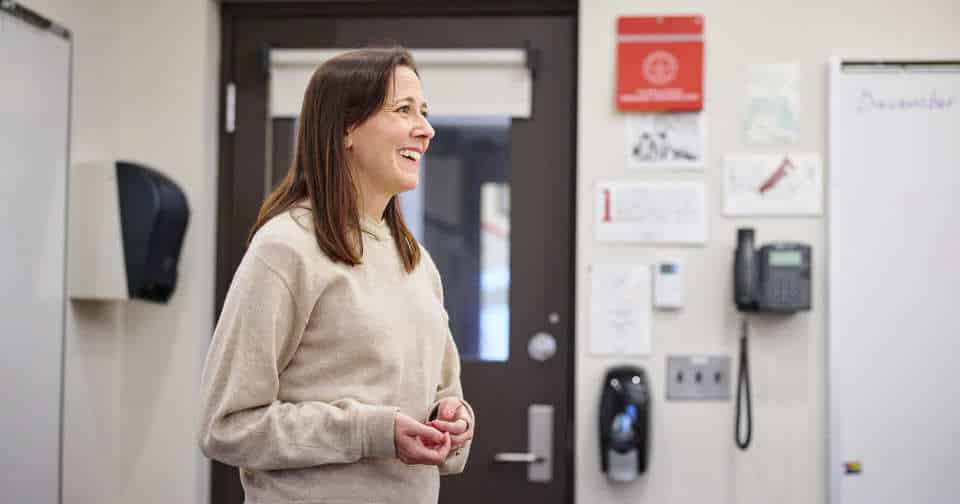
Running a Nigerian tomato paste company was never part of the plan for Mira Mehta ’02. But when you “stay curious,” as she encouraged students in Winsor’s Venture Capital and Entrepreneurship Club, life takes some fascinating turns.
“I thought I wanted to be an Olympic athlete,” she told the club on a recent visit to the school. She said the rigor of Winsor had taught her a lot about time management and prioritization, and prepared her well “for being a full-time athlete at an Ivy League school.” “You’re learning how to learn at a very fast pace,” she said. “That’s really important.”
Yet after years of rowing for Winsor, then for four years on Brown University’s D1 championship rowing team, attending summer development camps and pouring herself into the sport, she ultimately didn’t make the Olympic team.
So Mira quickly pivoted. Upon graduation, she got a job at the asset management company BlackRock. She told the club’s students that when she started there, in the marketing department, she “didn’t know the difference between a stock and a bond.” But the experience allowed her to dip a toe into the world of business while she looked for work that suited her better.
From BlackRock, drawing on her undergraduate major in community health, Mira moved on to a job with the Clinton Foundation’s Health Access Initiative, which at the time was doing HIV-related work. They told her they had a job opening in Nigeria—a country she’d never been to. So in 2008, she took the job and moved to Africa, sight unseen.
Her work with the Clinton Foundation focused on increasing the availability of HIV drugs at clinics around the country. Mira said the work was interesting, but it also revealed some gaps that making drugs more available wouldn’t solve. For instance, “Every time I went to a hospital on clinic day, the line is…just a mile long line. Everybody’s there to get their drugs. The drugs are free, but they’ve all spent money to get to the hospital. And they are all spending money on losing a day of wages to wait there.”
Mira also saw how the effects of HIV stigma affected people’s livelihoods. She shared the story of an airport employee whose wife had HIV, but whose own HIV tests twice came back inconclusive. However, when one of his colleagues found out he was going to get an HIV test, the man lost his job; he was left unemployed with no way to support his HIV-afflicted wife.
“At the end of the day, it felt like what people really need is money,” Mira said. “Not actually that much money, but enough so that they can make their own decision and that I don’t have to be a part of an organization that’s deciding what you need. You should be deciding what you need. So that got me interested in the idea of being a business owner.”
During certain times of year as she drove through northern Nigeria on her way to various clinics, Mira noticed vast fields of cut tomatoes drying in the open air. That got her curious. It turns out, “there are times of year when the tomatoes are in a huge oversupply, and farmers can’t make enough money because the price crashes…so the farmers will cut them in half and just dry them in the dirt and try to preserve them.”
Yet, curiouser and curiouser, Mira noticed something else as she began to learn to cook Nigerian cuisine: When she bought the ingredients for jollof rice and other popular West African dishes, the tomato paste always came from China. “I saw all the tomatoes lying on the road. I see that Nigerians like to eat tomatoes,” she said. “Why are we not processing them locally?”
The idea for her business, an opportunity “to create jobs…to create income opportunities for people,” was born. “But I had no idea how to do any of it. It was this pipe dream in my head.”
It was only when Mira returned to the States for graduate studies at Harvard Business School that her plan took shape. In her final semester, she put together a business plan, “entered into a bunch of competitions, pitched, learned a lot, got a lot of rejections, eventually won some money from the Harvard Business School social enterprise competition…and then used that money to start Tomato Jos”—the Nigerian tomato paste social enterprise that she runs.
Once she committed to the enterprise, the real work began. First Mira needed to learn to grow tomatoes. “They’re extremely delicate,” she said. “They’re very fussy. If it’s too much sun, they’ll burn. And if it’s rainy, they’ll bruise and get mold. And if there’s not enough water, this will happen. If there’s too much water, the roots will get rotten. And they’re susceptible to every single disease.”
After all that, once the tomatoes are safely off the vine, “you have to pick them and get them into the factory within basically 12 hours. So the whole supply chain of it is very intensive; you’ve got to manage it really well or you’re going to lose all the fruit.”
Refining this process took seven years, due to the natural constraints of the growing season. “Every time you learn something, you have to wait until the next season to apply it,” Mira explained. But finally, after years of learning and yet more setbacks caused by the coronavirus pandemic, Tomato Jos was up and running.
“Today,” she said, “we are a 100-person company. We have about a thousand farmers that grow tomatoes for us. We have the only functional tomato processing factory in Nigeria that takes fresh tomatoes and turns them into paste. And then we take the paste and we turn it into two retail products” sold across 20 states in Nigeria.
When asked how she manages all of the risks involved in starting a business, Mira told the students, “The most important thing is the passion. You have to really love—or think that you really love—it to do it.” She added, “You have to have that stubbornness in you, because a lot of the times [with] the risks, it doesn’t really make sense to do this, actually. It is a dream, and I’m trying to make a dream become a reality.”
Yet Mira stressed another important element of her success: her Winsor education, and the supportive network it affords her. “At the end of the day,” she told the students, “I have a really good education. I have a really good network. I feel like even if I fail, I can find another job. I can land on my feet, and I think that’s a big part of it, too. All of you guys have that by virtue of being here.”