

Blanding’s Turtles Arrive on Campus
It’s always an exciting week for Class I scientists when Blanding’s turtles arrive on campus. Winsor has participated in the H.A.T.C.H program—Hatchling and Turtle Conservation through Headstarting—since the 2018–19 school year.
Called “headstarting,” students give one-month old endangered Blanding’s Turtles a headstart for survival in the wild by caring for them indoors when they are at their most vulnerable. “Because the turtles have plenty to eat and do not contend with predators or winter, they grow to about the size of a four-year-old wild turtle,” explains Ken Schopf P’30, science faculty and Essential Chair in Science who spearheads the H.A.T.C.H program for Winsor.
In practice, Zoo New England conservationists track Blanding’s turtle mothers in the wild and protect their eggs. Hatchlings are distributed to schools across Massachusetts where students care for them and monitor their growth. At the end of the school year, once the hatchlings have grown to the size of a cheeseburger, Winsor students release their turtles during a field trip to Great Meadows National Wildlife Refuge in Concord, MA.
A biologist from Zoo New England joins Class I science classes as a guest lecturer each fall to introduce students to the turtles and lead a special lesson on conservation. Students learn that Blanding’s turtles face many obstacles to make it to adulthood. Eggs are eaten by foxes, raccoons, and coyotes. Hatchlings are small—about the size of a quarter—and predators can be anything: insects, chipmunks, frogs, snakes, mink, and fish. Safe in the Winsor science wing, the baby Blanding’s turtles can thrive.
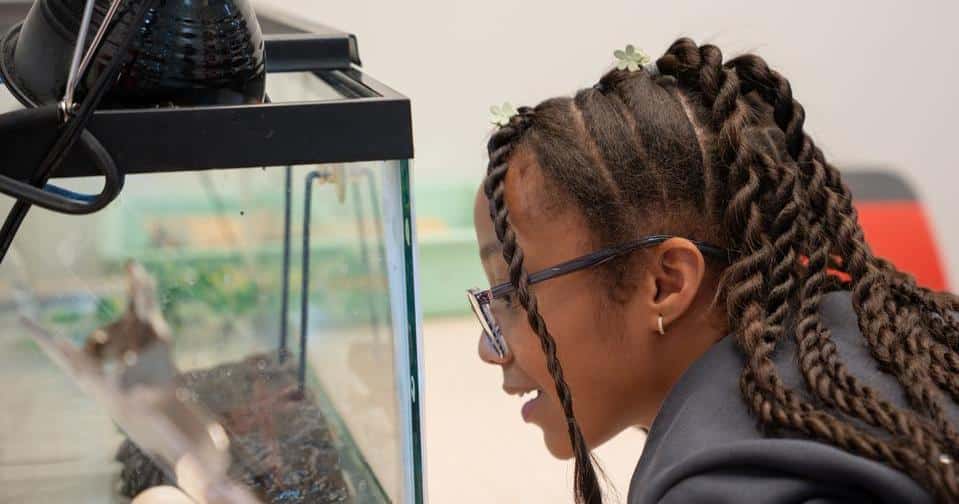
Mr. Schopf sets up the turtle tank to exacting specifications—the water temperature around 80 degrees (but 85 degrees is too warm for turtle safety), tap water is okay to use (but only if it’s been sitting out for a couple days so the chlorine dissipates), and a sunbathing platform fitted with a special UV light so the turtles get enough vitamin D to support shell growth. The tank is located at the end of the hallway just outside the Science Department office.
Eventually, a ‘turtle team’ of two Class I students will clean the tank—one of many rotating jobs that students will hold as they care for the Blanding’s turtles over the course of the school year. Winsor is caring for turtles number 2618 and 2619. Carefully chosen and voted on by Class I, the siblings received names: Snoopy and Peanut. At least once a month, Class I students will submit data to Zoo New England on turtle weight and body length.
Other turtle team jobs include twice daily feedings. Turtles aren’t fed in their tank but in a separate container. Students will have to scoop turtles out of their tank and place them in a separate container, being sure to add enough water to cover the turtles’ shells. Then, the turtles are offered the equivalent of an all-you-can-eat buffet for 15 minutes. In the wild, turtles are carnivorous eating insects and worms.
Adult Blanding’s turtles are about the size of a football and live from 90 to 100 years, but they are facing population decline. With habitat loss, roads, cars, and predators impacting the species, there are only about 1,000 Blanding’s turtles left in all of Massachusetts.
As part of an enduring partnership with Zoo New England, Winsor fifth graders continue to lend a helping hand and ensure the species doesn’t face extinction.