







From The Archives Fall ’26
Exploring The Winsor Bulletin’s Publication History
Volume one, issue one of the Winsor School Graduates Bulletin was published in March of 1934, and begins with the following rationale:
“This Bulletin is being launched by the Winsor Graduate Club, experimentally and somewhat tentatively, because we believe that there are many graduates like ourselves who would be interested in the changes of the school since their departure, in news of the accomplishments of other graduates and in the work of the Graduate Club. This first issue has been planned with these three aims in mind, and we are sanguinely hoping that, whether you are professionally, parentally, or merely abstractly interested in education, or whether you are merely curious about the experiences of your former schoolmates, you will find something in it to read and interest you.”
Following this section titled “Why the Bulletin?”, there is a letter from Winsor’s second director, Katherine Lord, an article about “The New Plan of Study”1 by (future head of school) valeria A. Knapp’16, Winsor Graduate Club news, general graduate news contributed by class secretaries, and a list of Winsor graduates currently enrolled in college. It concludes with a notice that the Winsor tennis courts are accessible to any graduate “if she has an identification card.”
This close examination of the very first Bulletin reveals why this vital school publication has persisted for over 92 years. By communicating both school-wide changes and functional information, the Winsor Bulletin has long been an agent to inform, connect, and inspire Winsor’s community at-large.
Beyond the rationale written in the first Bulletin, we do not have further documentation about the publication’s chartering. However, alumni organizations of other private schools and universities had long distributed bulletins of their own,2 so the Winsor Graduate Club (founded 1907) certainly would have been following in this publishing tradition. In its first decade of distribution, the Winsor Club Bulletin was published annually in some years, and biannually in others, but its contents were fairly consistent. As in the first Bulletin, there were typically notes about Winsor Graduate Club activities, an article by the Winsor School director, brief articles of general interest, and news about Winsor graduates.
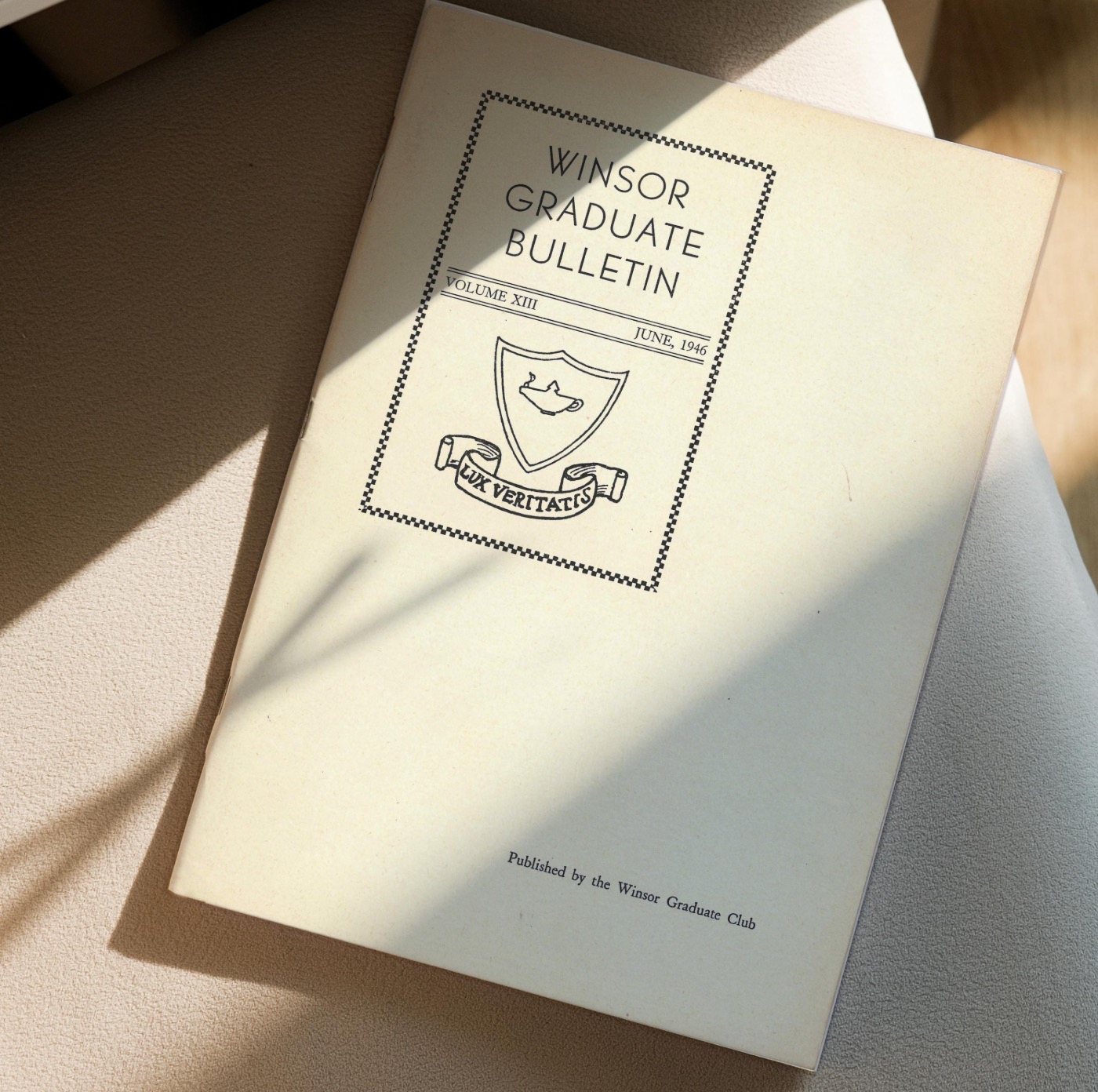
From an archivist’s perspective, our collection of the Winsor Bulletin (1934–present) holds tremendous historical research value. In addition to cataloging important biographical data about Winsor alumnae, the Bulletin’s stories shed light on timely school activities and concerns. For example, Volume XII of the Bulletin, published June, 1945, notes that “The Winsor Graduate Club has again had a quiet year because of the war.” World War II would have dominated much civic life and volunteer-based activities during this time. Through such details, the Winsor Bulletin can help us learn about the rhythms and activities of alumnae. The Winsor archives maintains one “access copy” and two “preservation copies” of each issue. With this collecting strategy, there is always an issue kept readily available for researcher use and digitization, as well as two mint copies designated for long-term storage.
Small editorial changes ensued during the following decades of the Bulletin’s publication. Its cover, for example, was first adorned by Winsor’s “lux veritatis” crest in June 1946, marking a departure from the traditional, text-based covers of the past.
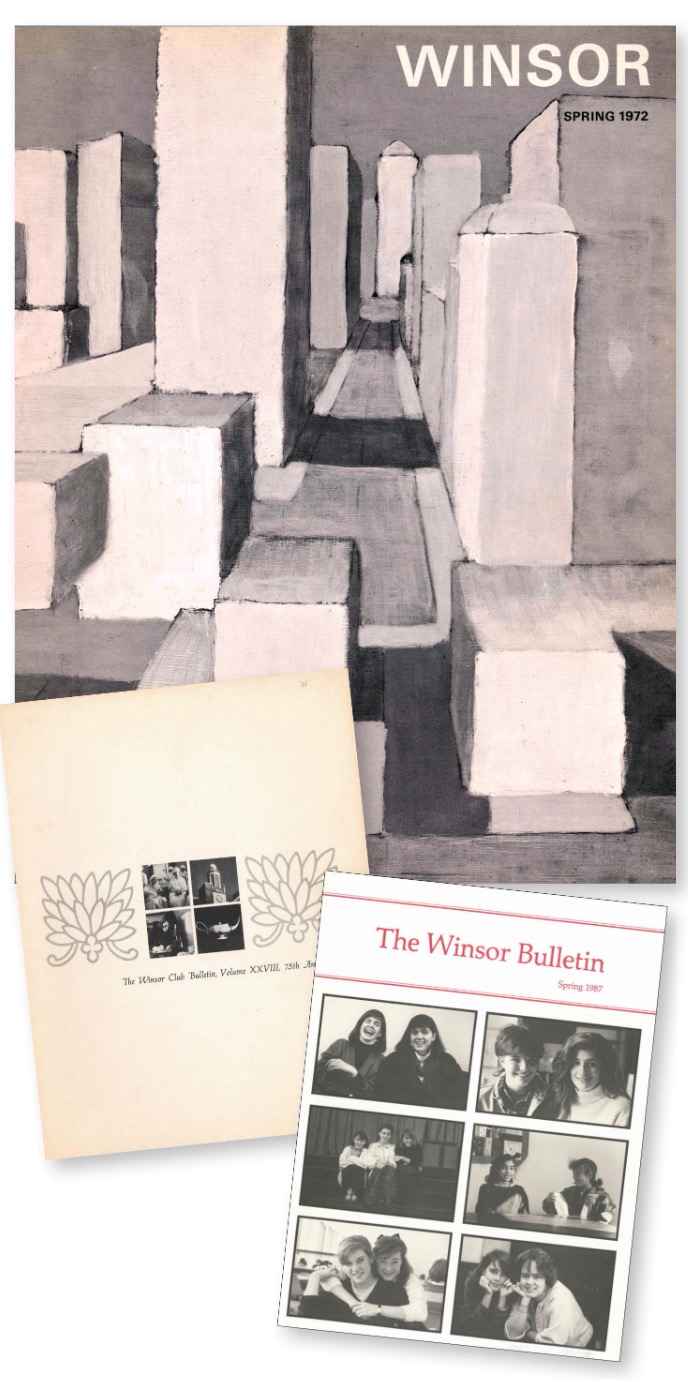
Issue 28, June 1961, was a special 75th-anniversary issue. This magazine brought the Bulletin into its larger, letter-sized page format, which it has largely maintained to this day. In addition, this 1961 issue changed the publication credit from the Winsor Graduate Club to the Winsor School, itself. Stylistically, the 1961 magazine ushered in an era of much more photography and editorial layout creativity.
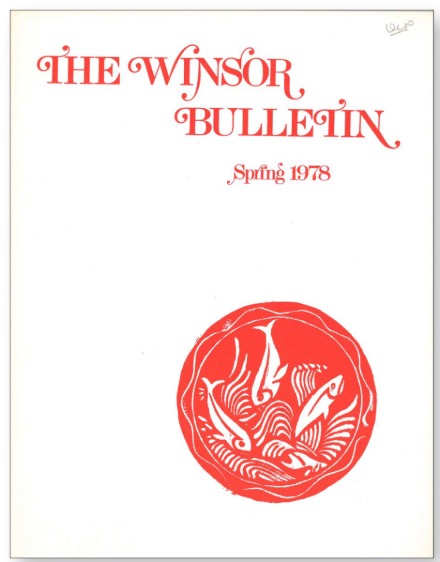
The Winsor Graduate Club was renamed to the Winsor Alumnae Association in 1964–1965. In 1972, the Bulletin first adopted a more pictorial cover design, featuring an abstract painting by lisa bailey ’75 in Class V. Successive issues featured student artwork on the front and back covers until 1985–1986, which were special Centennial issues. The Bulletin has, since the 1970s, continuously featured student, faculty, and alumnae artwork.
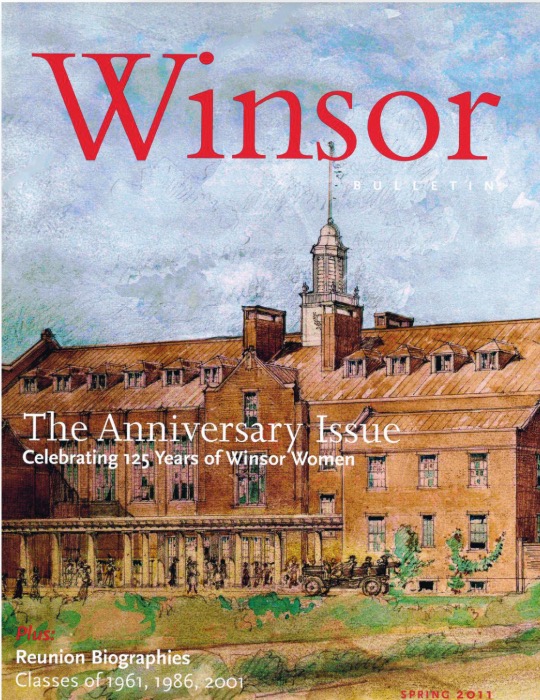
The Bulletin continued to develop slightly over the years, in both form and function. One notable contributor to the Bulletin’s publication history is Jane Hoeffel Otte ’57, P’84, ’86, GP’25, whose work as Winsor’s first official director of publications lasted from 1986 to 1994. For eight years, she served as the Bulletin’s editor. During this time, the magazine transitioned back to photography-based cover designs.
Born of the ongoing desire for awareness and connection, the Winsor Bulletin is indeed a remarkable publication with a rich history. It can prove challenging to collect periodical collections such as the Winsor Bulletin, thanks to disruptions such as mailing errors, publication schedule changes, and volume/issue enumeration changes. For these reasons, the Winsor Archives is missing copies of several issues. If you have copies of the Winsor Bulletin or any other archival materials you’d be interested in donating to the Winsor Archives, please reach out to me at cmcneil@winsor.edu.
1 In 1932–1940, Winsor took part in an eight-year national study conducted by the Progressive Education Association, funded by the Carnegie Foundation, “to find out whether the traditional college entrance requirements and examinations made any difference of success in college, and what secondary schools would do if these requirements and examinations were abandoned.” This is referred to as The New Plan, and consisted of somewhat interdisciplinary and localized curricular revisions.
2 The Harvard Bulletin was first published in 1898, the Radcliffe Bulletin was first published in 1906, and Dana Hall School’s Bulletin has been published since at least 1912.