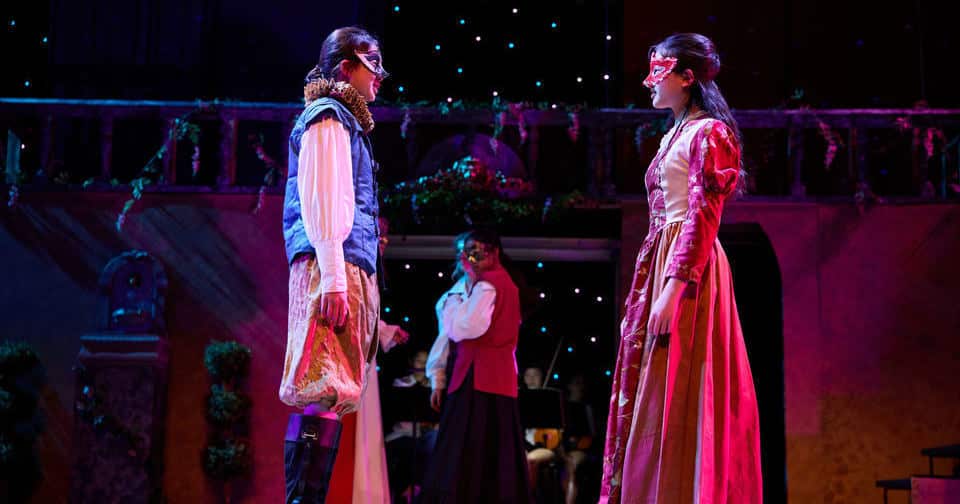





From Verona to Arizona: Class IV Presents Romeo and Juliet, Two Ways
Given how proudly Winsor wears its commitments to both tradition and innovation, it’s no great surprise that Class IV performed two separate productions of Romeo and Juliet this week—one set in Renaissance Verona, Italy, in keeping with the original script; and one set a bit further afield, in the Wild West of the mid-1800s.
Now in its 95th year, the Class IV Shakespeare project at Winsor continues to create a class-wide opportunity for collective learning, deep connection, and the discovery of new worlds waiting in the playwright’s timeless words. “Shakespeare is a major capstone event for the entire class,” says Theater Director Jeremy Johnson. “It allows them to work with each other on a common goal.”
Between Thursday and Friday, the students presented their two interpretations of the play to various communities across campus, with a production of the Renaissance version for the Lower School on Thursday afternoon, a presentation of both versions to parents and families Thursday night, and a final presentation of the Wild West version on Friday morning (after which they enjoyed a well-earned pizza party hosted by the Performing Arts Department and Class IV parent volunteers).
The dual play format is, admittedly, a clever practical solution to how to make sure all Class IV students are equally involved in the production of a play with a limited cast. “Each student acts in one play and then serves on a committee supporting the other play,” says Head of Performing Arts Felicia Brady-Lopez.
These committees, explains Mr. Johnson, include those responsible for the set, costumes, and music. “The sets are painted, the music is played, and all backstage work is completely done by the Class IV students,” he says—with preparatory teaching and guidance from Technical Director Andres Puigbo, Costume Designer Jessica Pribble, Music Director Andrew Marshall, and Ray Neufield P’29, who assisted with painting and building.
But alongside the logistical necessity of two productions, the fact that Class IV is tasked with interpreting and reinterpreting this well-worn material presents opportunities to dig deeper into the story’s themes and get creative with how they’re expressed through all the elements of the production. “We looked at how these two rival families and their hatred of one another leads to tragedy,” says Mr. Johnson.
In both iterations, he goes on, “it’s important to clearly delineate the families…The Capulets in both productions primarily wear red, and the Montagues wear blue. This can help the audience track relationships and alliances between characters.” As for the production designs, “We looked at images from the Italian Renaissance as well as period photos and images from Tombstone, Arizona, and old westerns to come up with the designs for the set.”
The Shakespeare project can prove to be an especially meaningful milestone in a Winsor student’s experience. “Many students remark after the fact that they got to know students in their own class that they didn’t know very well,” says Mr. Johnson. “They also get the opportunity to see friends and classmates in a new light as actors, stage managers, designers, or musicians.”
The value of such an experience can last far beyond when that final curtain falls, or that last tumbleweed crosses the stage. “Several students over the years have also remarked that Shakespeare was the moment when they realized how much they liked the Performing Arts and have gone on to participate in the program in Upper School,” Mr. Johnson says. “It remains a powerful bonding event at the end of their time in Lower School, and many alums can also remember their class’s Shakespeare play and their specific roles (some can still quote some of their dialogue!).”
Watch the full video and check out the program of this year’s Class IV Shakespeare project.