


Growing Community and Belonging Through Art
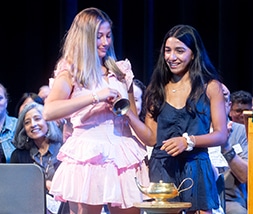
Thursday, September 21—After an introduction by SAFA (the Student Association for Fine Arts), Winsor welcomed socially engaged multimedia artist Elisa H. Hamilton to assembly. Recently named the recipient of the Brother Thomas Fellowship from The Boston Foundation, Hamilton places an emphasis on shared spaces and helped students understand how public art can grow community and create belonging. “You have to intentionally invite folks in,” she said, “community is something we carry with us, and in order to create community you have to keep sharing who you are, and ask people to share who they are.”
While Hamilton’s voice carried across the David E. and Stacey L. Goel Theater, her manner of speaking softly into the microphone created the feeling of a one-on-one conversation and had listeners pitched forward in their seats with rapt attention. To understand who she is now as an artist and as an adult, Hamilton shared with students, faculty, and staff a childhood photo. Bundled in a snowsuit, playing with her sibling and parents on the Boston Common, the audience saw a laughing family, a white mother, and a black father. Hamilton identifies as black and biracial, and admitted that, especially growing up in a white neighborhood, it was a process to grow into and claim that identity.
The idea of finding and cultivating what brings us together deeply informs her public art. First defining public art, she spoke about art that is experiential, performative, and interactive. She is drawn to “designing projects that are incomplete without community participation. Participatory art invites people in,” she said. Offering a brief look at recent projects, the sense of joy and togetherness is a common theme.
With Dance Spot in 2012, Hamilton tried to solve a problem for commuters in Boston’s Fort Point neighborhood in the Seaport. “People looked so grouchy,” she said. To change the narrative, she invited people to dance. Her elaborate chalk art transformed sidewalks into dance floors with arrows illustrating where to spin and step. “There is something incredibly powerful about unexpected joy,” shared Hamilton. The project bloomed into a five-year run stretching from Nashua, New Hampshire to Philadelphia.
This sort of ephemeral art is temporary—after all, chalk washes away—and with Sound Lab at the Isabella Stewart Gardner Museum in 2017 she was able to hold tangible space for stories. Capturing the sounds of ordinary lives, Hamilton collaborated with local community organizations and recorded each group at work, resulting in custom picture discs featuring the sounds and images of the community. Atop a 400-square-foot map of Boston, museum visitors were invited to touch, hold, and play these records on locally made turntables alongside a daily Sound Lab Open Mic. This sort of participatory art creates different entry points allowing folks to watch from the outskirts, join with a nudge, or dive right in—an engagement process that Hamilton referred to as “paddle, swim, dive.”
In an unexpected moment of joy, students started passing out story cards to everyone in the audience and Hamilton invited the entire auditorium to participate in her current project, Jukebox, right then and there. She urged, “listening together can be an incredibly meaningful experience.”
The instructions were simple: Look at the prompt on your card.Think about a story that you have. Turn to the person next to you and take turns sharing stories.
Prompts on the story cards varied: Share a story about a time when you were part of a team. Share a story about moving from one home to another.
In assembly, the audience usually watches, but with Hamilton’s at the helm, everyone was participating. The atmosphere in the auditorium became boisterous and cheerful and students, faculty, and staff swapped stories. “Stories help us develop a deeper understanding of each other,” explained Hamilton.
Jukebox is a permanent and public art project that explores the power of amplifying and sharing stories and how it is meaningful to have someone hold your story and archive it. Transforming a vintage jukebox from a machine that plays music into a public artwork that plays community stories, Hamilton has been listening to and recording stories from people with ties to Cambridge. Commissioned by the City of Cambridge under its Percent-for-Art Ordinance, she partnered with the Cambridge Public Library, the Cambridge Black History Project, and The Loop Lab.
“Historically, stories from black folks are underrepresented in archives,” explained Hamilton. In Jukebox, “over half the stories are told by black folks—we’re uplifting historically underrepresented stories and collecting stories that may go unheard.”
The jukebox, which she named Judy, is on display at the Cambridge Foundry, a center for creativity and collaboration for the Cambridge community. While Hamilton is still recording stories for the archive, anyone can go visit Judy and press play.
Finishing with a Q&A, one student asked, “Is the Jukebox the only permanent art exhibit you have?” After pausing for a moment to reflect, Hamilton answered, “Yes, most of the public art that I do is temporary.”
Laughing, she added, “I learned something about myself today from your question!”
Inspired by Hamilton’s work, SAFA will be leading Winsor in a community art project later this year.
