

How One Alum Is Reimagining Life in Space
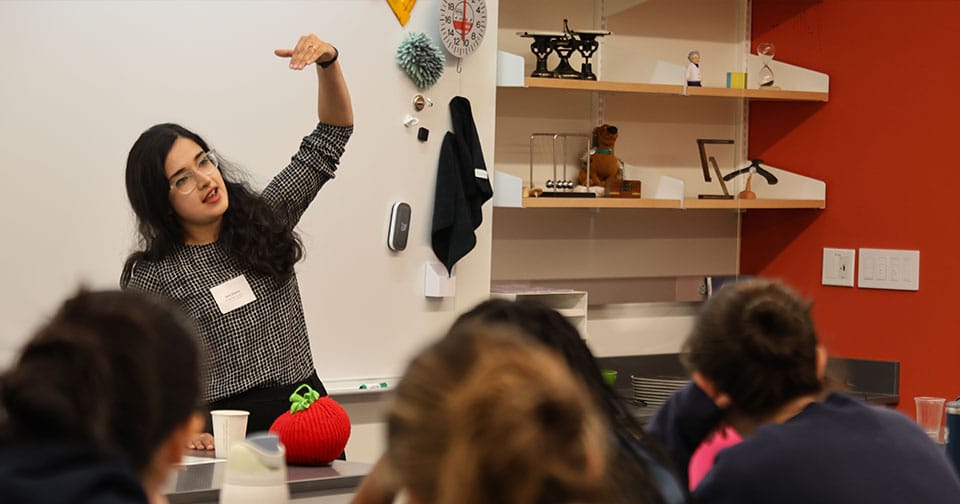
First taking the stage at an all-school assembly and then dropping into classes like AP Physics to meet with students, emerging technologies designer Sana Sharma ’10 returned to Winsor. “‘Emerging technologies designer’ is a fun way of saying I couldn’t quite choose between the sciences and the arts and have found a way to do both with my time,” joked Sana.
Indeed, Sana has worked on quantum computing, designed coding interfaces, written her own custom G-code for 3D printing, and even developed visualization toolkits for genomics and for generative AI. While her work now lies at the intersection of science, art, engineering, and design, she impressed upon students that it was a fairly circuitous journey. “The path I’ve taken has been varied and broad and a little bit convoluted,” she said, encouraging students that it’s okay not to have everything figured out.
Today Sana is both co-founder and advisor at Aurelia Institute, a nonprofit space architecture research and development lab, education and outreach center, and policy hub dedicated to building humanity’s future in space for the benefit of Earth. She also leads research at the MIT Media Lab for the Astronaut Ethnography Project, which distills the lived experiences of astronauts and cosmonauts for the next generation of designers and builders for space. Prior to her work in space, Sana held design leadership roles across a diversity of scientific domains at IBM Quantum, Watson Health, and the Broad Institute of MIT and Harvard.
Following an interest in physics, anthropology, and art, Sana received a Bachelor of Arts degree in architecture from Yale University, where she developed an interest in human-centered design. “I really loved the idea of being able to meet people from different backgrounds, learn from them, and figure out how I might be able to build things that serve them,” she said. Sana went on to earn a master’s degree from the Harvard University Graduate School of Design. That motivation and human-centered approach continues to inform her work in the science and technology pipeline.
At assembly, Sana shared some of the questions that she’s been asking during her recent work in the field of space, as well as some of the prototypes she’s been building to try to get answers to those questions.
“Sci-fi really inspires scientists and engineers to build cool and emerging technology, sometimes in really interesting and compelling ways,” she told students. A designer and researcher at the MIT Space Exploration Initiative—which she describes as “a ragtag group of creative technologists who are interested in democratizing access to space”—she and her colleagues are prototyping our collective sci-fi space future. The group serves the broader MIT community, helping them turn their research into things that might be space-applicable—at the moment there are more than 40 in-house projects ranging from smart suits and space health to 3D printing in zero gravity. Yet while sci-fi can be an interesting starting point, Sana questioned whether there might be a better way to motivate the future of space that doesn’t involve the hashing and rehashing of fictional tropes.
That was the initial impetus for the Astronaut Ethnography Project, which uses interviews and other qualitative research methods to learn more about life in space beyond the mission or the science. “We’re really curious about everyday life and what that feels like in zero-G,” explained Sana, who helped interview the first cohort of 15 spacefaring individuals including astronauts, cosmonauts, and spaceflight participants (a polite word for “space tourist”).
Interviews yielded a treasure trove of information. For example, it’s common to develop calluses on the tops of the feet from using them to hook and stabilize, making shoes with traditional soles impractical. Away from the hum of normal life on Earth, a huge importance is placed on meal time in space for sharing, trading, and building cultural bridges between individuals and crews. Several spacefaring folks describe their experience like “living under your desk at the office,” which prompted Sana and fellow creative technologists to consider designs for acts of community and care, such as dining room tables and sofas where people can gather and relax. Data from these sorts of interviews continue to help Sana answer the driving question, “How are we going to make space enjoyable?”
A project that Sana leads at the Aurelia Institute is actively exploring space architecture to support that question. The TESSERAE: Exhibition Pavillion is a life-size terrestrial mockup of the TESSERAE habitat concept—a modular, self-assembling space architecture paradigm made up of a series of magnetic tiles that can stack flat in the payload fairing of a rocket. Each tile is seven feet wide, and as they’re released into zero-G, electropermanent magnets allow the structure to self-assemble into truncated icosahedrons—essentially the geometry of soccer ball shapes. “The hope is that we can attach more and more of these soccer balls to effectively organically grow a space habitat. So it has just as much space as you need,” explained Sana. “This is in contrast to the tin can method of space station construction, where you have a bunch of sealed cylinders, you stick them all together, you have one configuration, and then it burns up once you’re done.”
The TESSERAE Pavilion was designed and fabricated as part of a residency at the Autodesk Technology Center Boston, where the team was selected as a finalist in the 3D Pioneers International Design Competition. The Space Habitat Pavilion had a soft-launch in summer 2024, coinciding with the International Space Station Research and Development Conference in Boston. From there it debuted to the public as part of the “Home Beyond Earth” exhibit at Seattle’s Museum of Flight, which ran through January 2025. The TESSERAE Pavilion then traveled to Vancouver, where it hosted hundreds of visitors for TED 2025.
The TESSERAE Pavillion served as a platform to both innovate on space habitat interiors and as an exhibition and education space for people to talk about what it’s like to design and build at scale for meaningful and resilient zero-G concepts with a home-like feel—a green vault for growing plants, a fermentation station for making kimchi, a living room-type setting with a zero-G couch, and more.
In 2022, Aurelia Institute sent six tiles about the size of a hand to the International Space Station. This is part of the “spaceflight hardware” testing the magnetic bonding paradigm and how these structures are going to come together. Another upcoming flight will test onboard computing and hardware to make a full, 32-tile mini soccer ball module this time.
The ultimate vision is to develop the architectural platform that helps grow a space station over time to support more people and more spaces. Simultaneously, should the spacefaring population shrink, the module can flat pack away so that it doesn’t burn up in the atmosphere and contribute to waste. With the International Space Station likely coming down in the next couple of years, there are already private companies looking to build the next iteration. “What we’re hoping to do is to attach one of our soccer ball modules onto one of those new stations. And so ideally, sometime in the next couple of years, decades, we’ll see TESSERAE in space,” said Sana.
Beyond the physical architecture, looking into near-term use cases, Sana shared there’s a lot of promise in doing biologic research such as protein crystallization in space. “We’ve been looking into not only supporting people as they live in space, but also doing cutting-edge research,” she told students.
To conclude her talk, Sana encouraged the Winsor audience to question, “Who gets a seat at the table as we build in the future, and how might we make that table bigger?” Regardless of discipline—science, arts, or something completely different—she added, “I am so excited to see what future you all build, as well as how you might invite your communities to join in in that building.”