Lessons from Summer Reading: Courage in Action
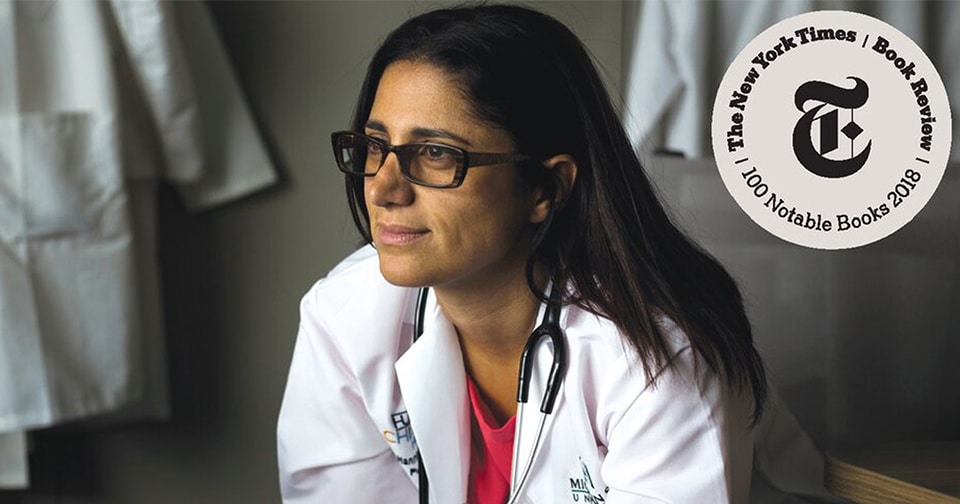
The Winsor community gathered this fall for an inspiring virtual conversation with Dr. Mona Hanna, author of What the Eyes Don’t See: A Story of Crisis, Resistance, and Hope in an American City. Chosen as Winsor’s 2025 summer reading selection, Dr. Mona’s memoir chronicles her courageous role in uncovering the Flint water crisis and her ongoing advocacy for children’s health, environmental justice, and the power of civic action.
Hosted by Bezan Chair for Community and Inclusion and History Faculty Julian Braxton, the evening brought together faculty, parents, and students to reflect on the book’s central themes of courage, integrity, and community engagement. The discussion was moderated by Head of Upper School and Science Faculty Kimberly Ramos, with Lower School History Faculty Ivana Brown and Winsor parent and pediatrician Liz Oh P’26, ’28 serving as panelists.
In her introduction, Head of School Meredith Legg P’32 reflected on how Dr. Mona’s work embodies Winsor’s core values. “Her story reminds us of what we hope to inspire in our students—the confidence and strength of character to know that one person, one woman, one voice, can make a difference,” she said. “Her book was the perfect opportunity to highlight our value of excellence above perfection.”
Throughout the evening, Dr. Mona shared how her journey from a high school environmental activist to a pediatrician-turned-whistleblower has shaped her commitment to science, justice, and storytelling. She spoke about the unexpected path that led her to write What the Eyes Don’t See, a process she described as “maybe harder than medical school,” and about how her early experiences as a student prepared her to take bold action later in life.
“My ability to do the work that I did—and continue to do—was really created in high school,” she said. “Those experiences taught me the power of good policy, of teamwork, and of using your voice to make a difference.”
Dr. Mona emphasized that the Flint water crisis was not a story of one hero, but of a collective effort. “This was not about me—it was about a team,” she said. “We accomplished what we did because people from all backgrounds came together. I thought that maybe pediatricians had a monopoly on caring for children. I was proven so wrong. Because so do water engineers. And so do social workers, and so do lawyers, and so do teachers, and so do so many other people. That team became quite broad. And when you can build that tent of all kinds of different people, you’re able to accomplish so much more.”
Reflecting on her decision to go public with her research on lead exposure in Flint’s children, Dr. Mona described the personal cost of speaking truth to power and the unshakable sense of duty that kept her going. “Every data point was a child,” she said. “That’s what gave me the strength to keep fighting. Because this was never about me. It was about them.”
She also spoke candidly about the erosion of public trust in science and institutions, encouraging students and educators alike to engage with science through storytelling and empathy. “We’re in a state of bizarre science denial,” she said. “But we can rebuild trust when we communicate clearly, tell human stories, and remember why we do this work—to make the world a better place.”
Dr. Mona’s conversation with the Winsor community also touched on her ongoing work in Flint, including the innovative Rx Kids program, which provides direct cash support to new parents and infants to combat child poverty. “In a city once known for poisoning its kids,” she said, “we’re now reimagining what it means to care for one another.”
When asked what action she would want every Winsor student to take, Dr. Mona offered a simple but powerful challenge: “Just practice being a changemaker,” she said. “The change doesn’t have to be big—it can be a tiny thing. But take that first step.”
As the discussion drew to a close, Dr. Mona left the community with one more piece of advice—rooted in curiosity, compassion, and lifelong learning. “Knowledge is power,” she said. “When [we] read, every nugget [we] get is power to be able to see the world differently. Reading gives us these different perspectives on how we can see this world and how we can make this world a better place. So read.”
To learn more and continue this important conversation, check out the Virginia Wing Library “Summer Read” page.