



Bulletin Fall ’26
Bulletin
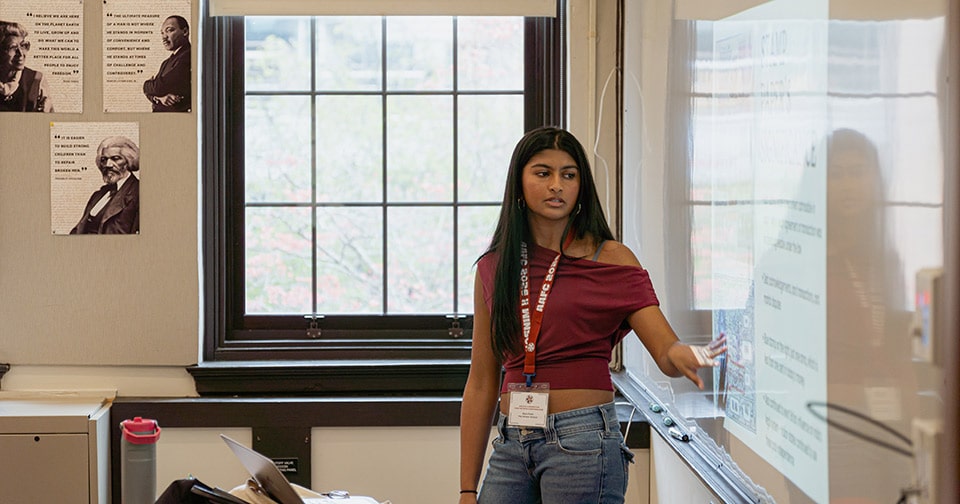
Winsor Hosts Asian American Footsteps Conference
In April 2026, Winsor hosted the Asian American Footsteps Conference, which brings together Asian, Asian American, and mixed-heritage Asian students from schools across New England. Founded in 2011, the conference provides students with a space to explore issues specific to their experiences. This year’s planning committee chose the theme “Creating Common Ground: Connecting with Our Communities” to highlight the importance of shared experience and true connection.
“The joy and community is the most important part,” says Jessica Wang, Upper School mathematics faculty and community and inclusion coordinator. “This is why students and adults from different schools keep coming back—especially the ones who traveled two or three hours to get here.”
The conference, which is hosted by different participating schools on a rotating basis, comprises a full day of workshops and affinity group sessions, allowing students to dive into particular topics and connect with other attendees. This year’s Winsor planning committee, which was led by Ms. Wang and included six students, added a slate of opening games before the morning keynote speech, allowing attendees to mingle and meet one another before the formal program began.
“Planning the conference was one of the highlights of my Winsor experience,” says EllaPaterniti’26, one of the student directors. “It was really cool to bring in so many people from other schools to participate.”
Ella and her fellow student directors focused on fostering connection among attendees, as well as curating a broad range of workshops and sessions. On the day, they visited multiple workshops to observe and lend their support (including the History of Ramen workshop, which had the bonus of a ramen tasting).
Student-facilitated workshops included such weighty topics as mental wellness and dealing with microaggressions, as well as lighter subjects, including a history of Asian drinks and finding oneself through K-pop dance. Ms. Wang calls the conference “a great leadership opportunity” for students who facilitated workshops, as well as for the student planners. The committee met many times to determine the event’s values and focus, and then to hammer out logistics and other details. They designed and sold t-shirts bearing the conference logo, with the proceeds going to Rice Sticks and Tea, an Asian-focused food pantry in Boston.
“It was a great experience to host the conference,” says Ella. Ms. Wang agrees: “The students were proud to show that Winsor could put on a great conference. And they got to connect with one another in both serious and joyful ways: having meaningful discussions about shared identities, and also having fun together.” ●
Spirit in Season: Celebrating Spring Sports
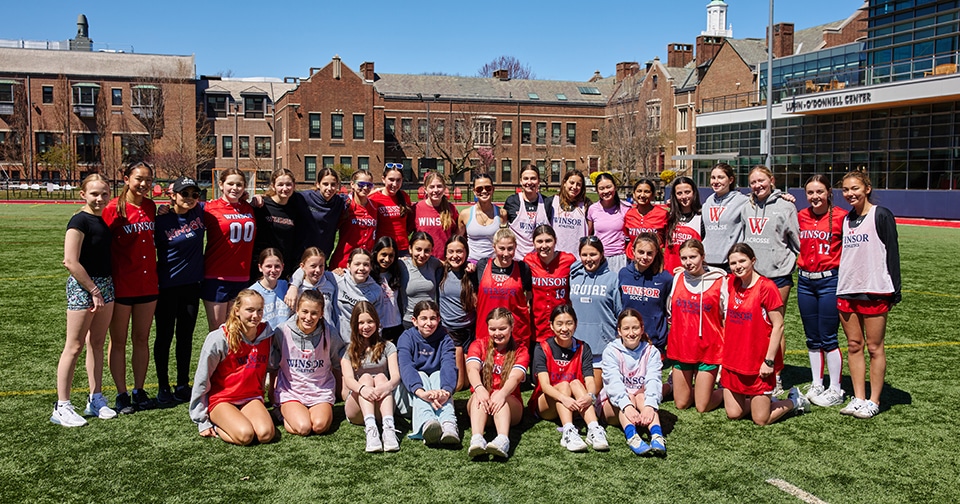
On Saturday, April 11, Winsor brought student-athletes, families, and fans together for a day of clinics, competition, and school spirit at the first-ever Spring Rally, a celebration of Winsor’s spring sports. The day began with members of the varsity lacrosse and softball teams leading clinics for groups of Lower School players before the varsity teams took the field to play a slate of afternoon games in front of supporters.
“This experience was about building relationships across divisions and giving our younger students a glimpse into the culture and commitment of our Upper School programs,” Director of Athletics Trina Hable said. “Our varsity athletes demonstrated outstanding leadership throughout the morning. They led warm-ups and drills, and they created an environment that was both supportive and inspiring.”
One of the athletes participating in the clinic was SanaKhan ’27, who said the experience was “super fun” for the team. “I didn’t know a lot of the lower schoolers, so this was a great opportunity to get to know and meet them,” she said.
Following the clinics, students ate a catered lunch together in the Wildcat Room. Varsity teams then got ready to take on EIL opponents Portsmouth Abbey, while the lower schoolers stepped into the spirit of the event. Before the games began, they gathered around tables to make posters and pick out rally items— red sunglasses, red hair bows, red pom-poms, and more—to cheer on their fellow Wildcats.
The sidelines during the varsity games that afternoon were filled with energy, a sense of Winsor pride, and a whole lot of red as the younger Wildcats got to support their older counterparts who had coached and encouraged them earlier in the day.
“We were also incredibly grateful for the outstanding showing and support from our parents and the broader Winsor community,” Ms. Hable reflected. “Their presence and enthusiasm helped elevate the entire experience, reinforcing the strength of our community and the shared pride in our student athletes.”
Both lacrosse and softball competed hard in their matches to finish out the day. The work of all the athletes involved in Spring Rally, both on and off the field, raised the bar for representing their programs with kindness and leadership. The Winsor students and families in attendance were also model supporters, bringing a tremendous amount of energy and spirit to Pilgrim Road.
“This experience captured exactly what we strive for in Winsor Athletics—connection across grade levels, student leadership, and a program where athletes feel supported and proud to be part of something bigger than themselves.” ●
Lower School Closing Ceremony
Processing toPachelbel’s Canon and holding a single white rose tied with a red ribbon, Class IV students made their entrance to the David E. and Stacey L. Goel Theater for the 36th annual Lower School closing ceremony on June 8, marking the end of the school year and their time in the Lower School.
“Gratitude…. We hear the word often, but I wonder if we spend enough time thinking about what it really means,” said Head of Lower School Sharon Jones Phinney, who provided the welcoming address to assembled families. “Gratitude is the process of noticing…. As we come to the end of this year’s school year, I hope you will take a moment to notice what we have received from one another,” she said.
Ms. Phinney also recited the poem “When Giving Is All We Have” by Alberto Rios. Reflecting on the rich texture of Winsor’s Class IV community, she said, “Each of us brings something different. Different strengths, different experiences…alone, those gifts matter, but together—yes, together, they become something greater.”
Selected by Class IV, this year’s musical offering was “The Climb,” originally recorded by Miley Cyrus and written by Jessi Alexander and Jon Mabe. As Class IV sang this moving ballad, they were accompanied by Performing Arts Department Head Felicia Brady-Lopez on the piano and directed by Performing Arts Faculty Andrew Marshall.
Class IV speaker Clara Go ’30 began her speech referring to the famous rapper/singer Bad Bunny’s “old man”–costumed look at this year’s Met Gala. She reflected on his idea that aging could be an art. “If aging and growing up is an art, then these past four years, our class has made a masterpiece,” she said. “Growing up isn’t just about getting older or moving onto the next thing, it’s about the people and experiences that shape us along the way.”
Outgoing Lower School Council heads Dani Peskin ’30 and Carys Musto ’30 then transferred school leadership to the newly elected Lower School Council Heads, Shylee Feingold ’31 and Alex Chen ’31. “Do not be scared to try new things…. Make the most of every moment with your friends,” Dani urged her Lower School classmates.
Rising 2026–27 Class VIII President Emma Roffman ’27 encouraged the incoming freshmen to make new friends and try new things. “Keep an open mind, and drop any assumptions you’ve made about your classmates these past four years, and just be kind to everyone,” she said.
Class IV Coordinators Josh Constant and Emily Moran also offered bits of advice. “Continue to work to be your best selves. Know that it is an ongoing journey, and there will be bumps along the road. When things get hard, take a deep breath and make the best choice you can with the information you have,” Mr. Constant said.
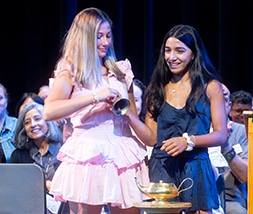
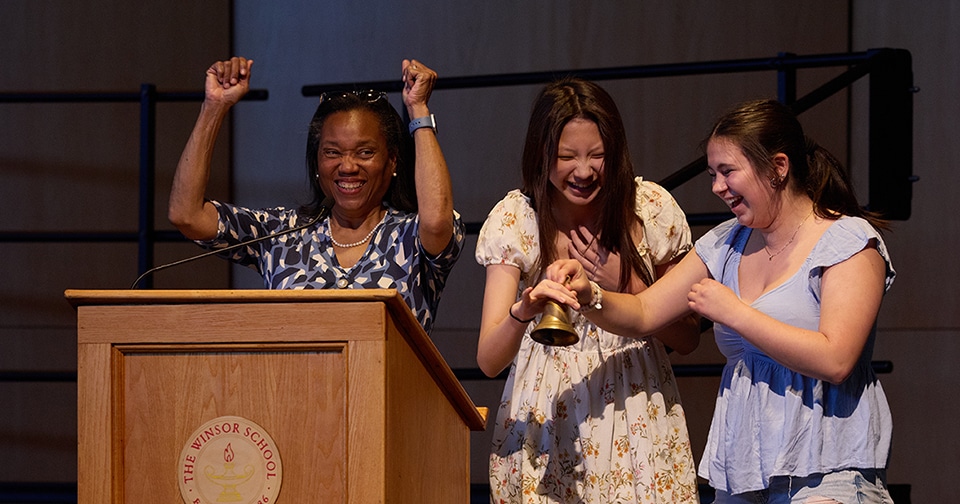
After Ms. Phinney and Ms. Legg conferred the certificates to members of Class IV, new Lower School Council Heads Shylee and Alex rang Miss Winsor’s bell to officially close the school year. ●
A Living Symbol of the Civil Rights Movement Comes to Campus
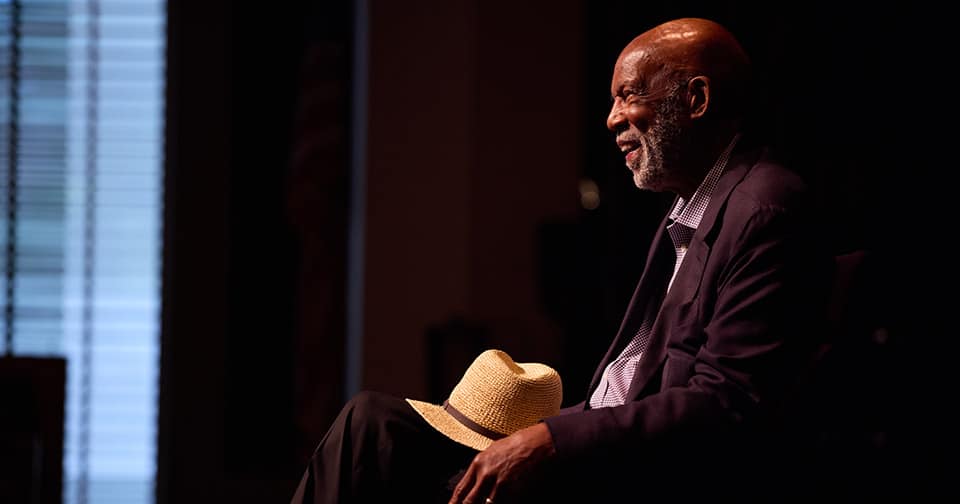
On Friday, May 22, Winsor hosted a special assembly with Dr. Terrence Roberts, a clinical psychologist and member of the Little Rock Nine, whose enrollment at Central High School in Little Rock, Arkansas, helped fight for school integration and became a symbol of the Civil Rights Movement.
Joined by students from Boston Latin School, Winsor gathered in the David E. and Stacey L. Goel Theater for a conversation between Dr. Roberts and student panelists. Caroline Specht ’28, Josie Go’28, and Bailey Hall ’28 introduced Dr. Roberts, speaking about their Class VI United States History research coursework on the Civil Rights Movement.
“The names we tend to remember are often the ones in positions of power…. But the people who actually walked through the doors of Central High School are sometimes remembered more as a group than as individuals,” explained Caroline, who researched the years-long struggle to desegregate Southern schools before Little Rock made national headlines.
Upper and Lower School panelists then joined Dr. Roberts on stage. When asked what gave him strength to keep attending school amid intense hostility and isolation, Dr. Roberts shared: “Whatever happens, I will learn how to confront it.… People who don’t have an opportunity to develop in that sense tend to shrink, dissolve, disappear—I didn’t want to disappear.”
Dr. Roberts recalled taking a “vow of nonviolence” as the Nine organized, inspired by lieutenants who worked for Dr. Martin Luther King Jr. He said community was a central tenet of the Civil Rights Movement, bringing people together to fight for change. The bond he found within the Nine has lasted: the seven living members, he confirmed, are “like a small family.”
Following the Q&A, Illumina, Winsor’s Upper School choral group, led by Performing Arts Faculty Andrew Marshall, performed “Hope Lingers Here” with a spoken word section featuring Nia Lawrence ’26.
Boston Latin students and several Winsor classes later met with Dr. Roberts in smaller discussions, and he closed his Winsor visit with lunch alongside Lower School students. These smaller sessions provided yet another forum for students to connect and learn from Dr. Roberts’s inspiring life and work.
“Terrence Roberts’s visit is one of those rare assemblies that students and faculty will talk about for years to come,” said Director of Community and Inclusion Julian Braxton. “His wisdom and keen insights about both the past and the present were incredibly powerful. At the same time, his wit and humor came through in such authentic ways. He is the kind of person whose stories, reflections, and perspective hold your attention from beginning to end. I am so grateful that he came to Winsor.” ●
Honoring 250 Years of American History with a New Civics Curriculum
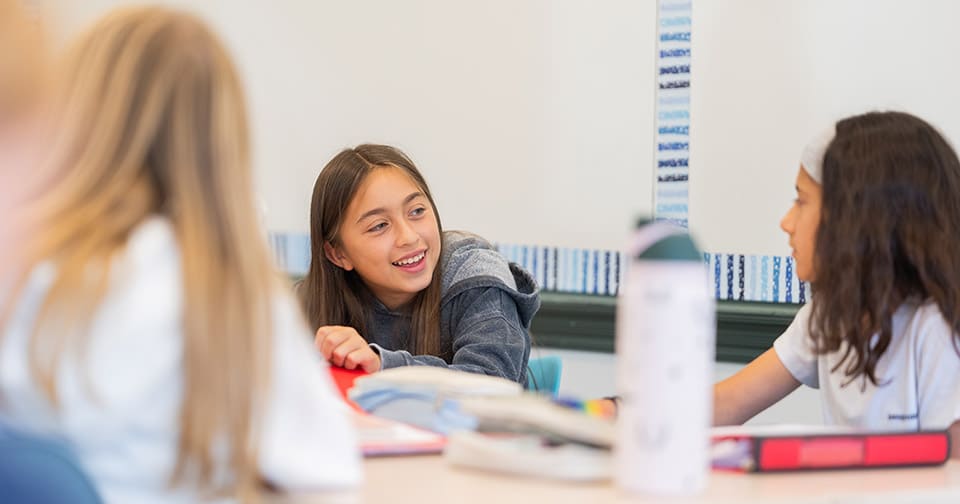
2026 marks both the 250th anniversary of the Declaration of Independence and, coincidentally, the debut of a new civics curriculum for Class III at Winsor. Under the new curriculum, civics will be taught for a full year in Class III and revisited during United States History in Class VI.
An internal review of Winsor’s broader curriculum resulted in several specific recommendations for history. Building on these recommendations, the History Department began a review of its curriculum and made adjustments designed to provide students with a stronger foundation in U.S. history and an increased focus on civic engagement, something the History Department recognized would best meet the needs of today’s Winsor student.
According to Ann-Marie Holland, head of the History Department and the Alice C. Jenckes Chair in History, the new framework allows students to explore political and civic life in greater depth throughout their middle and early high school years. For example, Class III will be introduced to the Constitution and the concepts of federalism, the separation of powers, checks and balances, political rights, different branches of government, and the Enlightenment ideals that inspired the American system. In Class V, students will have a unit on Enlightenment thinkers as part of their year studying modern European history. By Class VI, they will be prepared to examine the articles of the Constitution in greater detail.
WHY NOW?
“Following the most recent accreditation process, one of the recommendations for the school was to undertake a curriculum review,” says Ms. Holland. “As we began that work in the History Department and broader school community, it quickly became clear just how valuable and necessary a comprehensive review would be.” The resulting internal three-year review concluded
robust civics program in the Lower School. The broader Lower School community/civics theme aligns with the desire for more opportunities for meaningful community engagement and could culminate in a Lower School capstone project.
The History Department used the Democratic Knowledge Project’s (DKP) curriculum as the foundation to structure the new course. The DKP provides resources for schools to develop civics curriculum that deepens knowledge of, and support for, constitutional democracy. In addition, the department worked with Primary Source, a local nonprofit that collaborates with teachers to foster students’ skills for thoughtful and engaged citizenship.
THE NEW SEQUENCING
Integrating the new civics curriculum not only added a new course, it also led to restructuring history education from Class I all the way through Class VI. Prior to this year, Class I studied early American history, Class II learned about ancient civilizations, and Class III explored the Silk Road. Now, Class I will study ancient civilizations (starting from Mesopotamia), Class II will take a course called Cultural Traditions and Encounters, looking at the Silk Road and Africa, and Class III will have Civics: Foundations and Practice of American Democratic Ideals. The curriculum for Classes IV and V will remain the same: The Birth of Modern Europe followed by Modern Europe and the Problems of Power. Then, Class VI will devote a full year to the United States History course. While the new curricula for Classes I, II, and III are in the process of being implemented, the department is now turning its attention to the later grades, considering how those courses can evolve to complement and build upon the changes made in the earlier grades.
What will be gained, in addition to giving students a stronger foundation in U.S. history, is a sweeping civics education covering not only American government, but also the media literacy skills needed to navigate today’s news and social media landscape, and the tools for productive, open dialogue across differences of opinion.
History faculty are also working with colleagues across Class III to integrate civics-related themes into lessons on science, wellness, math, art, library studies, and world languages. For example, a science unit on environmental policy might examine how policy is shaped by media coverage, government priorities, and diverse values. Math class might cover sampling and polling, misleading graphs, and Electoral College math.
Ms. Holland says she’s looking forward to seeing how the students will integrate civics ideas into their final capstone projects. Throughout the year, students will keep journals reflecting on their personal, community, and national values, building toward a capstone project in which they identify a cause they care about and lay out a course of action they could take.
To start the school year, Class III used their annual retreat day to visit the Boston Public Library, where they viewed a copy of the Declaration of Independence on display as a part of the nation’s semiquincentennial celebration. The History Department is also working on setting up field trips to the Edward M. Kennedy Institute for students to participate in a simulated U.S. Senate session, along with a mock trial at the John Adams Courthouse.
With new sequencing and a new civics course now firmly in place, the History Department’s next task, Ms. Holland says, will be to “fine-tune our approach as we go.” Over the course of the 2026–27 academic year, faculty will be taking dedicated time to evaluate progress as they pioneer a fresh approach to teaching history. ●