






Cover Story Fall ’26
Leading the Field: A History of Athletic Leadership
If one were to walk in Boston Common in 1886, they would’ve seen Winsor students engaging in Swedish gymnastics and calisthenics during their breaks. Today, a Winsor athlete looks slightly different, playing for one—or more—of Winsor’s 14 competitive sports teams, donning red and white uniforms, and being cheered on by fans at events like Under the Lights.
Athletics have always been integral to the Winsor experience. But how did we move from calisthenics on the Common to winning as a Wildcat? The answer lies with the leaders of Winsor Athletics, who are remembered fondly by those they taught, but whose work has largely gone underrecognized.
Winsor’s earliest documented director of physical education was May P. Fogg, who also worked as a teacher and coach from 1938 to 1960. Fogg was a graduate of Sargent College at Boston University and a 1938 founder of Camp Merestead, originally a sleepaway sports camp for girls, in Camden, Maine.
Working alongside her was Barbara Goss, who chaired the Physical Education Department at Winsor from 1942 to 1962. Miss Goss, who graduated from the Boston School of Physical Education in 1924, spent time at Melrose High School in Melrose, Massachusetts, and at the Masters School in Dobbs Ferry, New York, before coming to Winsor. Miss Goss introduced field hockey to Massachusetts in 1925 and was a fervent advocate for the establishment of girls’ interscholastic sports in Massachusetts.
But it was Chloe King, who arrived at Winsor in 1962 as the head of the Physical Education Department, and Nancy Bilodeau, Winsor’s eventual director of athletics, who spent much of their combined 60 years at Winsor expanding the number of competitive sports offered and shaping Winsor Athletics into what it looks like today.
Miss King and Miss Bilodeau’s paths to Winsor looked very different. Miss King came by way of Tufts University and the Women’s College at the University of North Carolina, where she earned a master’s degree in physical education. Her passion for coaching girls centered especially on field hockey, which she took charge of each fall. Miss Bilodeau, by contrast, was hired in 1975 straight out of Ithaca College, where she’d earned her own degree in physical education. Largely unfamiliar with the independent school ecosystem, Miss Bilodeau arrived at Winsor ready to learn the ropes.
A New Era
For Miss King, coming to Pilgrim Road was the fulfillment of a dream that began in her junior year at Tufts University. During that time, she was a student teacher at Winsor, and she quickly fell in love with Winsor’s commitment to girls’ education. Following her graduation, Miss King had waited nearly three years for a position to open before she set out to head Winsor’s department of five physical educators.
“It was really luxurious, because no school with 400 students at that time had that many physical education people teaching,” Miss King reflects. “We all did coaching and we all did everything.”
In a time before Title IX, Winsor was a leader in promoting girls’ athletics. Students enthusiastically participated in PE class and also a few interscholastic sports like field hockey, basketball, and tennis. Still, particularly in her early years, Miss King had to contend with parents whose “cultural differences” wouldn’t allow their daughters to play sports.
“We had several wonderful children who would have enjoyed sports and would have had so much success in them,” she says. “But sometimes, a mother was so eager for her child to succeed at Winsor, that she said, ‘No, no, no, she has to come right home and do her homework.’ So what could you do? We couldn’t fight that.”
When Miss Bilodeau arrived on campus in 1975, she initially held a part-time position coaching at Winsor. Eventually, she became Winsor’s first officially titled director of athletics. Given the limited athletics facilities on campus, her early days were spent educating students throughout the Longwood area, which she called an “interesting learning experience.”
“It was just a different atmosphere for me,” Miss Bilodeau says. “I would have to get dressed in dress clothes to come to school, then I would have to change into my warm-up suit to teach. If I went across the street to the gym, I’d have to change back into my dress clothes again…. All I felt like I did was change all day.”
One of Miss Bilodeau’s biggest surprises upon coming to Winsor were the school’s limited options for interscholastic athletics programs— she felt as though there needed to be more variety than the few Winsor offered.
“There weren’t a lot of teams,” Miss Bilodeau says. “There was field hockey; there was no soccer. And if it was fall and you didn’t play field hockey, you really didn’t play for a team.”
Miss King and Miss Bilodeau worked to establish many of Winsor’s modern-day offerings—including competitive crew, squash, cross country, ice hockey, and track programs—over the course of the next 25 years. This increase in sports teams encouraged more students to participate in athletics, a core tenet of Miss King and Miss Bilodeau’s pedagogies that continues to resonate today at Winsor.
“Children who are as bright as Winsor girls need a balance in their life,” Miss King says. “They need music, art, drama, sports, all of those what they call ‘peripheral things’ that are absolutely vital for their development…. And if they can’t sing and they can’t play sports, their life is not full.”
Picking Up the Baton
Miss King left Winsor in 1997, and Miss Bilodeau departed Pilgrim Road in 2001. Succeeding Miss Bilodeau was Karen Geromini, a former Division I field hockey and lacrosse player at the University of New Hampshire. In college, Ms. Geromini was a team captain and three-time D1 All-American. She also competed at the highest levels for the United States National Women’s Field Hockey and lacrosse teams from 1983 to 1989. Before moving to work at independent schools, Ms. Geromini was an assistant coach for UNH’s field hockey and lacrosse teams from 1988 to 1992.
Given her high-level athletic background, Ms. Geromini arrived at Winsor from Thayer Academy with an immense amount of passion for Winsor’s athletic potential.
“When I came to Winsor, I wasn’t sure that students looked at themselves in the mirror and saw themselves as anything other than just students,” Ms. Geromini says.
Ms. Geromini sought to raise Winsor’s standards for athletics, knowing that stronger athletics could enhance the student experience without compromising the school’s emphasis on academic excellence. One of her biggest undertakings as director of athletics was replacing the school’s meticulously maintained grass fields with turf in 2008—a change critical for outdoor sports in notoriously erratic Boston weather.
“The turf fields really enabled us to sustain a program of consistent practices and game schedules, because we didn’t have to cancel practices and games when it rained,” Ms. Geromini explains. “They also enhanced our physical education program because students were able to do more outside as well.”
Home Field
In 2015, Ms. Geromini left her position as director of athletics to become Winsor’s director of operations—now chief operating officer. Sherren Granese, a former field hockey player at Springfield College with Hall of Fame honors and former Boston College Field Hockey and Lacrosse coach, assumed Ms. Geromini’s role. Ms. Granese had come to Winsor in 2009 as assistant director of athletics after spending five years in the same role at Simmons College. She then moved up to associate director of athletics in 2012.
Ms. Granese’s appointment as Winsor’s director of athletics in 2015 coincided with the opening of the Lubin-O’Donnell Center, an infrastructure improvement that Ms. Granese says allowed “programs to take off.”
“With squash, we had a varsity team with maybe 15 to 20 kids,” Ms. Granese says. “When the LOC opened, we suddenly had three teams and a club team with 60 kids involved.”
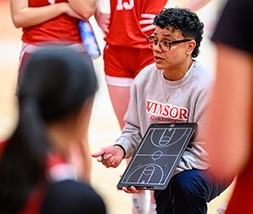
Squash wasn’t the only program that benefited from the new construction. In 2017, Winsor’s after two students, Samantha Chin ’19 and Michelle Pu ’20, went to Ms. Granese and asked her about starting a volleyball program. The idea quickly grew from one small, unofficial team to a full program with varsity, JV, and middle school teams. In 2024, the team won an EIL championship on its home court in the LOC.
“It was really special,” Ms. Granese says about the championship-winning team. “To see them celebrate, it brought tears to my eyes to see them work so hard and be rewarded. That was incredibly special.”
Surging Forward
assistant director, and associate director of athletics, Trina Hable is stepping up into the director of athletics role this fall. Ms. Hable was a four-year starter and captain for the women’s lacrosse program at Syracuse University, and a founding member of the team, arriving the year the program launched. She earned All-American honors, set program records that still stand, and competed on a full athletic scholarship.
Ms. Hable says she sees the value of Winsor Athletics’ versatility and aims to preserve it.
“What I love about Winsor is that we’re built for the many and the few at the same time,” she says. “A student here can pick up a field hockey stick for the first time in seventh grade, or she can arrive as a serious club athlete with college aspirations, and both will be challenged, coached, and cared for.”
And while her previous 10 years at Winsor have seen teams earn 34 EIL championships across six sports and 13 additional regional titles, Ms. Hable is interested in promoting the whole athlete image to every Winsor student.
“The championships are wonderful, and we’ll keep chasing them,” she says. “But the trophy I care about most is the woman who walks into any room in her life afterward knowing she belongs there.”